Showing posts with label critic. Show all posts

Friday, March 30, 2012

The real face of Indian Sports Authority - An institutional Failiure

Pathetic.. I know no other words to say.. The sports authority of India is in absolute shambles... They seem to see nothing beyond cricket as sports. Its unfortunate that such a non-mainstream sports is favoured or rather worshiped than anything else..

Should sachin be awarded Bharat ratna...?? Damn it I say.. even he wouldn't agree to be awarded the highest honor at the cost of other sport for the modest person he is...
Inset Message: Shashikant Hotkar , winner of Mumbai Shree for the year 2011, making papad with his family in Dharavi Slum , Mumbai.

We give so much importance to cricket and cricket players as compared to other games.. though these players perform well they still need to struggle in the daily life for living!!!!! Though they r doing hard work for making records for Indian games they doesn't get any help frm government... emphasizing the real need to change this situation


Its not about Shashikant or whether he deserves whatever he does, the perennial question is what the Sports Authority of India is doing with the worlds second largest population. Had they provided the sufficient infra structure with proper maintenance the situation would be rather different.
Its the very reason that we still are languishing at the bottom of the table every olympics struggling so hard to clinch atleast a Bronze cheering the mediocre success and crediting that to the non-sense sports Authority and the IOC who did not even to care to move their ass out for anything other than abusing the institution while even every small african countries and with people not even equalling the population of the capitol. 
When are we going to realize this very fact and act. I guess whatever the changes should be proposed should start fundamentally. Thatz where we lack. We lack the very foundation. We lack the very infrastructure. We lack the very culture where sports is treated in par with the success of other professions. Can you imagine somebody saying I play kabbadi or I play Football in india when they were asked what you do for a living ?? We'd joke at them as losers. 
This is what we should change and the rest takes care by itself when we introduce the sports as a compulsory eductaion or rather give more emphasis by giving some more credits like we do for Arts, languages, Mathematics and science.
I dont really know if these things gonna happen during my lifetime or the respected politicians would spare some time from facing their never-ending list of cases of corruption, crime, treason and the likes. Not that i should be worried about it now for I have long lost the grip of playing tennis or cricket and just play Ping pong to cut loose stress out of the maniacal work only tuning me to be a moron every progressing day.

Wednesday, March 23, 2011

Sports Preview shows - Mediocre Media and those mean men...

Too sick of watching the match previews on the eve of CWC2011... Esp the news channels like timenow, NDTV they hardly look appealing and are only concentrating on doing something flashy and filmy with all those nonsense comments and catch lines so mediocre written by mediocre ppl....

Even roping in those old hogs seems hardly helping it improve its content... Boria Majumdar (funny sports beureu journo) a self-proclaimed cric geek just goes on spitting watever comes across his mind claiming he has gotten some kinda heavenly dawn... Mandira trying so hard to luk cute and so pathetic in her all reavealing attire with those few gud oldtimes who themselves are trying hard to put to words whatever they think.. coz these crazy media maniacs would try to make miles out of every minute.... Dean jones is another hilarious piece of shit... Prof. Deano as they fondly call him... SOmehow the fiery batsman from OZ had gotten so deep into the shit which only goes to show how unsuccessful could he so as to stop commenting and running (acting rather) sports preview shows....

Sidhu however still seem to maintain his lordliness yet attracting his fans with all those siddhuisms...

Well the names goes on and on for its the time for all these bugger to reap whatever they did or did not sow... As long as indian ppl are so fond of gossips in sports irrespective of the veracity of the content these media preview shows gonna fish out for TRP's with those hard liners claiming whatever they hardly know of..

However ironic as it may sound it is a very evident truth that media is hardly ethical and loyal these days and are running for mere money than for the spirit of the journalism.

Thursday, December 04, 2008

Hotel Taj : icon of whose India ?

Gnani Sankaran- Tamil writer, Chennai.

Watching at least four English news channels surfing from one another during the last 60 hours of terror strike made me feel a terror of another kind. The terror of assaulting one's mind and sensitivity with cameras, sound bites and non-stop blabbers. All these channels have been trying to manufacture my consent for a big lie called - Hotel Taj the icon of India.
Whose India, Whose Icon ?

It is a matter of great shame that these channels simply did not bother about the other icon that faced the first attack from terrorists - the Chatrapathi Shivaji Terminus (CST) railway station. CST is the true icon of Mumbai. It is through this railway station hundreds of Indians from Uttar Pradesh, Bihar, Rajasthan, West Bengal and Tamilnadu have poured into Mumbai over the years, transforming themselves into Mumbaikars and built the Mumbai of today along with the Marathis and Kolis

But the channels would not recognise this. Nor would they recognise the thirty odd dead bodies strewn all over the platform of CST. No Barkha dutt went there to tell us who they were. But she was at Taj to show us the damaged furniture and reception lobby braving the guards. And the TV cameras did not go to the government run JJ hospital to find out who those 26 unidentified bodies were. Instead they were again invading the battered Taj to try in vain for a scoop shot of the dead bodies of the page 3 celebrities.

In all probability, the unidentified bodies could be those of workers from Bihar and Uttar Pradesh migrating to Mumbai, arriving by train at CST without cell phones and pan cards to identify them. Even after 60 hours after the CST massacre, no channel has bothered to cover in detail what transpired there.

The channels conveniently failed to acknowledge that the Aam Aadmis of India surviving in Mumbai were not affected by Taj, Oberoi and Trident closing down for a couple of weeks or months. What mattered to them was the stoppage of BEST buses and suburban trains even for one hour. But the channels were not covering that aspect of the terror attack. Such information at best merited a scroll line, while the cameras have to be dedicated for real time thriller unfolding at Taj or Nariman bhavan.

The so called justification for the hype the channels built around heritage site Taj falling down (CST is also a heritage site), is that Hotel Taj is where the rich and the powerful of India and the globe congregate. It is a symbol or icon of power of money and politics, not India. It is the icon of the financiers and swindlers of India. The Mumbai and India were built by the Aam Aadmis who passed through CST and Taj was the oasis of peace and privacy for those who wielded power over these mass of labouring classes. Leopold club and Taj were the haunts of rich spoilt kids who would drive their vehicles over sleeping Aam Aadmis on the pavement, the Mafiosi of Mumbai forever financing the glitterati of Bollywood (and also the terrorists) , Political brokers and industrialists.

It is precisely because Taj is the icon of power and not people, that the terrorists chose to strike.

The terrorists have understood after several efforts that the Aam Aadmi will never break down even if you bomb her markets and trains. He/she was resilient because that is the only way he/she can even survive.

Resilience was another word that annoyed the pundits of news channels and their patrons this time. What resilience, enough is enough, said Pranoy Roy's channel on the left side of the channel spectrum. Same sentiments were echoed by Arnab Goswami representing the right wing of the broadcast media whose time is now. Can Rajdeep be far behind in this game of one upmanship over TRPs ? They all attacked resilience this time. They wanted firm action from the government in tackling terror.

The same channels celebrated resilience when bombs went off in trains and markets killing and maiming the Aam Aadmis. The resilience of the ordinary worker suited the rich business class of Mumbai since work or manufacture or film shooting did not stop. When it came to them, the rich shamelessly exhibited their lack of nerves and refused to be resilient themselves. They cry for government intervention now to protect their private spas and swimming pools and bars and restaurants, similar to the way in which Citibank, General Motors and the ilk cry for government money when their coffers are emptied by their own ideologies.

The terrorists have learnt that the ordinary Indian is unperturbed by terror. For one whose daily existence itself is a terror of government sponsored inflation and market sponsored exclusion, pain is something he has learnt to live with. The rich of Mumbai and India Inc are facing the pain for the first time and learning about it just as the middle classes of India learnt about violation of human rights only during emergency, a cool 28 years after independence.

And human rights were another favourite issue for the channels to whip at times of terrorism.

Arnab Goswami in an animated voice wondered where were those champions of human rights now, not to be seen applauding the brave and selfless police officers who gave up their life in fighting terorism. Well, the counter question would be where were you when such officers were violating the human rights of Aam Aadmis. Has there ever been any 24 hour non stop coverage of violence against dalits and adivasis of this country?

This definitely was not the time to manufacture consent for the extra legal and third degree methods of interrogation of police and army but Arnabs don't miss a single opportunity to serve their class masters, this time the jingoistic patriotism came in handy to whitewash the entire uniformed services.

The sacrifice of the commandos or the police officers who went down dying at the hands of ruthless terrorists is no doubt heart rending but in vain in a situation which needed not just bran but also brain. Israel has a point when it says the operations were misplanned resulting in the death of its nationals here.

Khakares and Salaskars would not be dead if they did not commit the mistake of traveling by the same vehicle. It is a basic lesson in management that the top brass should never t ravel together in crisis. The terrorists, if only they had watched the channels, would have laughed their hearts out when the Chief of the Marine commandos, an elite force, masking his face so unprofessionally in a see-through cloth, told the media that the commandos had no idea about the structure of the Hotel Taj which they were trying to liberate. But the terrorists knew the place thoroughly, he acknowledged.

Is it so difficult to obtain a ground plan of Hotel Taj and discuss operation strategy thoroughly for at least one hour before entering? This is something even an event manager would first ask for, if he had to fix 25 audio systems and 50 CCtvs for a cultural event in a hotel. Would not Ratan Tata have provided a plan of his ancestral hotel to the commandos within one hour considering the mighty apparatus at his and government's disposal? Are satelite pictures only available for terrorists and not the government agencies ? In an operation known to consume time, one more hour for preparation would have only improved the efficiency of execution.

Sacrifices become doubly tragic in unprofessional circumstances. But the Aam Aadmis always believe that terror-shooters do better planning than terrorists. And the gullible media in a jingoistic mood would not raise any question about any of these issues.

They after all have their favourite whipping boy - the politician the eternal entertainer for the non-voting rich classes of India.

Arnabs and Rajdeeps would wax eloquent on Nanmohan Singh and Advani visiting Mumbai separately and not together showing solidarity even at this hour of national crisis. What a farce? Why can't these channels pool together all their camera crew and reporters at this time of national calamity and share the sound and visual bites which could mean a wider and deeper coverage of events with such a huge human resource to command? Why should Arnab and Rajdeep and Barkha keep harping every five minutes that this piece of information was exclusive to their channel, at the time of such a national crisis? Is this the time to promote the channel? If that is valid, the politician promoting his own political constituency is equally valid. And the duty of the politican is to do politics, his politics. It is for the people to evaluate that politics.
And terrorism is not above politics. It is politics by other means.

To come to grips with it and to eventually eliminate it, the practice of politics by proper means needs constant fine tuning and improvement. Decrying all politics and politicians, only helps terrorists and dictators who are the two sides of the same coin. And the rich and powerful always prefer terrorists and dictators to do business with.

Those caught in this crossfire are always the Aam Aadmis whose deaths are not even mourned - the taxi driver who lost the entire family at CST firing, the numerous waiters and stewards who lost their lives working in Taj for a monthly salary that would be one time bill for their masters.

Postscript: In a fit of anger and depression, I sent a message to all the channels, 30 hours through the coverage. After all they have been constantly asking the viewers to message them for anything and everything. My message read: I send this with lots of pain. All channels, including yours, must apologise for not covering the victims of CST massacre, the real mumbaikars and aam aadmis of India. Your obsession with five star elite is disgusting. Learn from the print media please. No channel bothered. Only srinivasan Jain replied: you are right. We are trying to redress balance today. Well, nothing happened till the time of writing this 66 hours after the terror attack.

Friday, October 17, 2008

Sourav Ganguly: Victim of a revenge cult - cricketnext.com

Unjustified criticism is a popular media pastime in most parts of the world. Knock over the hero image and belittle his or her achievements by humiliating their performances.

The more public it is the better for those would-be assassins who, for the sake of stirring controversy have the comfort of their offices or studios in which to sit and fire sniper-like vitriol at the intended victim.

It was in early December 2004 during the Kanpur Test that involved South Africa when NDTV asked me to become involved in a discussion on Sourav Ganguly, his perceived lack of form as well as leadership skills.

The way questions were posed brought the realisation that on the other side was a hit squad with an obvious grudge against Ganguly. It also made me wonder why I had been asked to take part in this show and in the firing line of Raj Singh Dungarpur, who came across as someone who didn't enjoy the Ganguly style at all.

Maybe because articles I had written much earlier, as well as those during the 2003-04 Australia tour for the Indian Express, had praised Dada and the way he had not backed off from a challenge against the Australians on that tour.

It has rarely ceased to surprise me that in the past fifty years or more, how players who have performed well for their country have been ridiculed by those who have not played a club game let alone a Ranji Trophy match or in a Test. Yet they sit and pontificate as though they have scored over 6,000 Test runs and taken more than 100 wickets.

There was also an awful feeling earlier this year in Sri Lanka that there were those media types who wanted Ganguly to fail. Want to point fingers and loudly say, "We told you... We told you... He is finished. Good... Good. Get rid of him now; forever."

Yet this was in a three-match Test series where most batsmen, not only Ganguly, fudged their lines against mystery spinner Ajantha Mendis and Muttiah Muralitharan.

In Port Elizabeth, before the start of the fractious second Test of India's 2001 tour of South Africa, and following the defeat in Bloemfontein after centuries by Sachin Tendulkar and that on debut by Virender Sehwag, I asked Ganguly about the enraged reaction in India to that particular defeat.

He was precise in his comments by saying he did not worry what his critics felt, or would say, or likely to say as they would not change their criticism even if India had won that first Test.

As with the NDTV episode with Dungapur, you felt they want him to fail, so that they could get out their rusty sabres and use his back as their personal dart board.

Forgotten is how months earlier he had defied a rampant Australian attack by scoring 144 in the first Test in Brisbane: walking out to bat with the top-order a mess at 62-3, Tendulkar lbw to Jason Gillespie for a duck, and later 127-4. But India still managed a first innings lead because of his century.

Also forgotten is how he led India to a World Cup final in South Africa when there are those on the subcontinent who wanted India to win but Ganguly to fail. The poison from that defeat in the final, it seems, still flows as swiftly as the Hooghly River.

What has been amusing in this latest Ganguly episode is how newspapers run interviews on half-baked supposed comments and offer them as being genuine. Anyone who stooped to this level to sell papers should be asked to account for his honesty. In another country, his job might be on the line.

All Dada can do here is refute the allegations that he made such comments while the reporter now has a credibility problem. What is known is that he has long been the fall guy when it comes to India's middle-order failures and you don't need the former captain to tell you that. It has been a known fact for a long time.

Now joining those snipers is some typically bad-mouthing Aussie who is doing his own ludicrous pantomime act.

To suggest that Ganguly had indulged in time wasting is an excuse for ignorance of the laws. The Channel Nine loud mouth overlooked that there were no overs lost, despite the interruptions. So why the fuss?

That the target was an impossible one is overlooked by such media bullies who snarl and snap when they can't get their way and attempt caricature humour to make a non-valid point.
How many Aussies in the past have also been involved in such a tactic to prevent defeat? Memories of a Perth Test against New Zealand in December 2001 resurface. Apart from several appalling umpiring decisions, they were calling for gloves and pads and other time-wasting tactic they could conjure.

The Kiwis didn't grumble, but you knew they weren't too happy either. There was Aussie criticism of Steven Fleming's plus 300-minute long century; no praise either for Daniel Vettori and his six wickets in the first innings that helped the Kiwis a good first innings lead. No honesty among thieves.

What needs to be appreciated here is that there is far, far more to Ganguly's style of play than statistical jargon and metaphorical branding.

He needs neither a register of meaningless allegories nor statistical lists that categorise who he is and from where he comes.

Yet for some peculiar reason, universally the Indian media, always seeking new cult heroes outside the outlandish tinsel confines of Bollywood, have this arcane obsession to indulge in such inane metaphors and clichés when discussing a man whose individual stylish left-hand batsmanship as well as leadership showed that Indians can take on the bullies from Down Under and elsewhere.

Those so fond of rehashing the meaningless 'Lord Snooty' as a way to unjustly caricature and pillory the man, or Prince of Calcutta to explain his elegant strokeplay, fail to understand his innate competitive drive.

There have been times when watching him place a cover drive suggests the soft growl of a Bengal tiger on the prowl. Here there is the impression of his sensing the mood of the bowler and by scoring a boundary in such a way it evokes an instinctive habit of his stalking of the bowler, seeking to hunt down the next ball as well.

There is a finesse about the Ganguly cover drive that hints how its execution is unique; it has nothing to do with textbook technique but his style of adventurism. He has had that trendy manner since before he was selected 16 years ago and sent to Australia.

Yet as he is about to say adieu to a Test career, Ganguly deserves fresh descriptions and a new landscape as a tribute to his skills and leadership: not old clichés or tired metaphors that have long failed to describe his style of game or intense personality.

There was agony in Australia in 1991-92 where he was largely misunderstood by a self-indulgent team management system; then a heroic debut century at Lord's a little more than four years later. These are all part of the often haphazard journey.

It is one though that deserves a far better epithet than it is receiving from a malevolent sniping media.

Monday, June 09, 2008

Image trouble - PINKY ANAND

Can the police go public with “evidence” when an investigation is still incomplete?

The character is like a tree and reputation like its shadow. The shadow is what we think of; the tree is the real thing”. Abraham Lincoln

Though the investigation in the Aarushi murder is still ongoing, the investigating agency has not done much to generate faith in their ability to discover the truth. The over anxiety to speak to the press and to bring every possible “evidence” to public knowledge appears hopelessly misplaced.

But this is not what this is about. Whatever may happen with the investigation or trial, the image of the teenager, the victim of this bizarre double murder, has been tarnished. The investigating agency has made public the “preposterous story” of the “objectionable position of the girl with the servant” without any basis.
Legal angle
Should the investigating agency have made public this allegation without any apparent basis? The National Commission for Women has rightly insisted that they would serve a notice upon Uttar Pradesh Police for using language that shows ‘disrespect’ towards women. The dead cannot deny or contradict these remarks. Reason and prudence demand that the investigating authorities should scrupulously abstain from making statements that amount to character assassination of a minor dead girl. Sections 499 (defamation) and 509 (insulting modesty of a woman) of IPC prescribe offences for defamatory statements. The Press Council of India has provisions barring use of “such” personalised statements specifically when a person is dead.

The laws of the country and the Supreme Court hold that the identity of a girl should not be disclosed. The Supreme Court dealing with a case of rape in State of Punjab vs Gurmit Singh (1996) said, “The courts should, as far as possible, avoid disclosing the name of the prosecutrix in their orders to save further embarrassment to the victim of (a) sex crime.”

Obviously, this confidentiality is meant to preserve the dignity of the victim and not to expose her to public shame. Strict adherence to high standards of ethical behaviour by the police is what the time demands. But, in this case, the 14-year-old girl, a minor now dead, suffers repeated character assassination by the police.

Trite though it is, even a perfunctory look shows that, when the victim is a girl, aspersions are frequently cast on her character as in the case of Hetal Parekh, the 16-year-old raped and murdered by Dhananjay Chatterji, who was ultimately sentenced to death.

This brings us to the question what should we do? Should the police be at liberty to make “evidence” public when investigation is not complete? Are the police governed by a code of conduct restraining them from maligning the character of a woman? Can the victim’s personal life be subject to public discussion because of such “disclosures”? Are the investigating agencies answerable for the character assassination of a minor victim? Do we need guidelines?

The writer is a senior practicing advocate, Supreme Court of India
Courtesy: The Hindu - Magazine

Thursday, May 29, 2008

How Gilchrist's squash-ball trick has helped Venugopal Rao get going


Adam Gilchrist's brutal century against Sri Lanka in the 2007 World Cup final - an innings that single-handedly won Australia the trophy and restored his image as one of the most destructive opening batsman the world has ever seen - will remain etched in the memory for a long time.


The fact that the innings ran into a brief controversy after the wicket-keeper-batsmen had used a squash ball in his left glove tends to get forgotten. The Sri Lankan team had lodged a complaint, but the International Cricket Council had cleared the batsman.


Now, in his stint with the IPL's Hyderabad team Deccan Chargers, Gilchrist has not only used the little squash ball for his own batting exploits, but has also advised the rest of his team members on the advantages of doing so. When his team mates in Hyderabad had asked him to explain the use of the ball, he said "it provides me with a better grip."


Among those who listened to what Gilchrist had to say, only Venugopal Rao decided to try it out. Whether it's a direct co-relation or not, the right-hander from Andhra Pradesh has managed an impressive 242 runs in nine IPL innings at an overall strike rate of 147.56 and is the team's third-highest scorer after Rohit Sharma and Gilchrist.


Rao's exploits in IPL have taken bowlers by surprise. Not known as a batsman who strikes the ball hard and clean, Rao has hit 14 sixes and 19 boundaries in the tournament so far, taking Hyderabad agonisingly close to victory from hopeless situations in two games.


"I am using the ball in my right glove. It gives me the advantage of a better grip. I took Gilchrist's advice and it's actually working well," Rao told The Indian Express.


Big impact


Rao says he'll continue using the squash ball as long as he's comfortable with it. In the match against Delhi at the Ferozeshah Kotla last week, Rao's 34 off 18 balls contained two sixes and three fours - and one six in particular, off Farveez Maharoof over long-on, was an example of Rao's comfort factor with the squash ball in his glove. The shot was played as late as possible and close to his body and the timing, says Rao, is reflective of the grip he enjoyed.


While none of the other members have made use of the golf ball yet, New Zealand's Scott Styris, who has witnessed the change in Rao's batting, is now trying to experiment with it himself.


Reacting to the Lankan team's complaint after the World Cup final, the ICC has legalised the use of a ball saying "it is not against the laws or the spirit of the game".


"Since there is no restriction in law even on the external form of batting gloves, let alone the interior thereof, no law has been breached," the ICC said.


In fact, the ICC representative had said at the time: "It's been suggested that if shoving a squash ball into your bottom glove makes you bat like Adam Gilchrist, then perhaps the ICC should make it compulsory".


Looking at the way Rao's batting, that day may not be too far away.

Friday, May 02, 2008

Indian Premier League - The icon's burden


The money, the freedom to build their own teams, and the challenge of testing themselves in Twenty20 have brought several problems for the big stars

Sambit Bal - May 1, 2008

VVS Laxman and Sourav Ganguly produced their most substantial performances of the tournament today, but, ironically, neither was substantial enough to secure victory for their teams. Was it a coincidence, or does there lie a bigger tale?


Ganguly's was a battling performance. His highest score of the tournament had been 14; his team had had two successive batting failures; and two of his major batsmen had gone home, leaving him to carry the innings. With his team chasing a tough target, he came out to open, and from the way he went about the job it seemed he had set his mind on batting through.


But as the overs ticked by, the asking rate, which started at an intimidating 10, kept creeping up and at the halfway stage, it was clear that desperate measures were needed. Ganguly was still there, on 30 at more than a run a ball. But that he had only faced 26 balls told a story: batsmen who take control usually manage to corner the strike. And it wasn't as if runs were raining at the other end.


Ganguly nearly holed out trying to up the pace, but Yusuf Pathan tripped over the ropes to give him a six, and an over later he earned himself a reprieve by coaxing the umpire to refer a catch that Graeme Smith claimed at deep midwicket for a replay, which, as it mostly does in such circumstances, was inconclusive. But he went cursing himself in the next over when Mohammad Kaif kept his balance to complete a catch on the boundary. There was an air of inevitability about that dismissal.

Laxman, by all accounts, played a delightful innings. It was very Laxman-like, crisp and wristy, and by his standards in the shorter versions, it was also furious. But he fell before the job was done, ironically, for the second time in three innings, to a legspinner. And his dismissal led to a slump from which the Deccan Chargers never fully recovered despite an innings of pure and precise hitting from Rohit Sharma. It was always evident that they finished at least 20 short.


Elsewhere, Rahul Dravid is grappling with his own nightmares. He has twice been dismissed first ball, and has been out slogging, flicking, pulling and hoicking in the most un-Dravid manner. His team languishes at the bottom having been outplayed thrice and once muffing up a match they seemed to have in their grasp.

Each of these batsmen seem to be getting better as the tournament progresses, but the problem is that run-a-ball 30s are simply not good enough. Not even 40-ball 50s. The impact innings of the tournament have been blazing hundreds. It is increasingly apparent that the innings that really matter are either the big ones or blinding cameos. Curiously, Ganguly's most meaningful innings so far has been the 30-ball 14 in the low-scoring thriller against the Deccan Chargers. It prevented a free-fall on a vicious pitch and helped his team scrape through.

And Sachin Tendulkar, the biggest icon of them all, already has a mountain to climb even before he has played his first match. Even though the Mumbai Indians won their first game the other night, they are clearly behind the front-runners and their batting needs a saviour. Tendulkar has had to deal with massive expectations all his life, but he is a newcomer to this form of the game, which is not always known to reward genius.

Call it the icons' burden.

It is ironic that four players who were not part of India's epochal victory at the World Twenty20 have been charged with the gravest of responsibilities for a Twenty20 tournament that promises to revolutionalise cricket. Three of them - Ganguly, Dravid and Laxman - are no longer considered good enough by the national selectors for the 50-over game, and Tendulkar had himself withdrawn from the World Twenty20. Yet, without them the concept of city-based franchises was a non-starter. They were needed not only as anchors and leaders, and for star value, but to give the concept elementary legitimacy.


Nor can they be blamed for accepting the job. The money was always hard to resist, and there need be no moralising about it: cricketers don't inhabit a different planet. But there was also the challenge of being part of a new idea, the chance of shaping a team with a freedom not usually granted due to national boundaries, and also a curiosity to test oneself in a different form.

But each of these factors have brought their own burdens. Having chosen to expose themselves to a form of the game that doesn't do justice to their great skills, it is their obligation to adapt. And having been anointed icons (all barring Laxman), and thus being the highest paid player in the team, it is inevitable that their performances will be measured against their value.

Twenty20 lacks many finer aspects of Test cricket. It lacks scope and scale; context and vision; intellect and subtlety. But it is not merely a hit-and-giggle. Slowly a pattern is emerging in batting. Of course, power is a big factor, but it is becoming increasingly evident that batsmen who rely more on hand-eye coordination are likely to have a greater chance of success. They are not necessarily lesser batsmen, but they are certainly different.

Should a group of players who have established their worth in the highest and, to many, the most demanding, form of the game, allow themselves to be belittled by a form that has little regard for their magnificent skills? It is a question they might confront soon if they haven't asked it to themselves already.

Sambit Bal is the editor of Cricinfo

© Cricinfo

Friday, April 04, 2008

Presenteeism - Going to Work Sick...

Adam of Lifehacker, writes about Presenteeism, which is being in the office when you are sick.

' The problem with presenteeism: It’s making your coworkers sick and it may be costing your employer a lot of money. So why do people do it? … '

I’ve known of cases where the employee was admitted in the hospital, and all that the supervisor could think about when calling the employee was - “I heard you are sick. How long will you be? Or, do you think you can come for sometime and finish this work?”

Well, now what can one say to that?

Thursday, April 03, 2008

Olympic Torch Relay. Aamir Khans Blog


Dear all,Over the last few days I have received several requests not to participate in the Olympic Torch Relay. Requests through members of my family, personal friends, people who are associated with the Tibetan struggle, and my blog.
I have gone through and read each and every letter, message and post pertaining to this issue. I would like to state that I have the highest regard and respect for the struggle that the people of Tibet are going through. I completely empathize with them. Similarly, I have the highest respect and regard for the struggle that the people of Iraq, Kashmiri Pundits who have been displaced, Kashmiris in general, and the people of Palestine, are going through. I have named above just a few instances of human rights violations. Across the world, and indeed within our own country too, there are several instances and examples of atrocities and human rights violation, which are still continuing. I categorically state that I am absolutely against any form of violence, and certainly I am deeply upset whenever the basic rights of human beings are violated anywhere in the world.
However, I feel that the Olympic Games do not belong to China.
In fact if we were to try and find on this planet a place to hold the Olympic Games where the government of that place has not been responsible for human rights violations (in one way or the other), then I suspect that we would be left with very few options, if any at all. If I am not mistaken almost all societies have been responsible for human rights violation either directly or indirectly, sometimes in seen ways and sometimes in unseen ways, sometimes physically, sometimes economically.
The Olympic Games represent for me the coming together of different people across the world despite their differences and difficulties. It is an opportunity for sportsmen and women across the world to showcase their talent, to challenge themselves and others, and for others to watch and marvel at the achievements of the human body, mind and soul.
Are human rights violations continuing across the globe while all this is happening. I’m afraid so. And I hope and pray for the day that we can one day live in absolute peace and harmony, where human suffering is done away with.
I am no one to tell any group of people how they should conduct their struggle. I am not part of it and am not going through what they are going through. But my heart goes out to them.
I request those of you who have asked me to stay away from the Olympic Torch Relay to understand that when I do run with the torch on the 17th of April it is not in support of China. In fact it will be with a prayer in my heart for the people of Tibet, and indeed for all people across the world who are victims of human rights violations.
Sincerely.
Aamir.

Monday, March 31, 2008

Bhutia says no to torch relay

This is the time for all those who feel for the Tibet cause to stand tall against the injustice Tibetians have been subjected to over the years. The dream of living in a free country is noT a crime under any law, but the Chinese Oppression is ceratinly the most heinous crime. China must respect the integrity and sovereignty of TIBET & TAIWAN and respect their culture and traditions.

The flame of protests seems to be raging mightier than the Olympic flame itself with protestors from over the world doing their bit to highlight the Tibetian point of view. In a shock for all, India football captain Baichung Bhutia refused to run with the flame when it reaches New Delhi on April 17.


The decision to not carry the flame was informed to the Indian Olympic Association on Monday through a fax after he had been bestowed with the honour of carrying the Olympic torch on the India leg of its journey.


Talking to a leading newspaper, Bhutia, a gifted athlete and a devout a Buddhist, said, ‘‘I sympathize with the Tibetan cause. I have many friends in Sikkim who follow Buddhism. This is my way of standing by the people of Tibet and their struggle. I abhor violence in any form.’’


The star footballer emphasized that he had not been requested by any group to pull out of the torch run. ‘‘This is an absolutely personal decision. I feel what’s happening in Tibet is not right and in my small way I should show my solidarity.’’


Bhutia is among a growing list of celebrities who have refused to carry the Olympic flame as a mark of protest against the violence done against Tibetians.


In February, Hollywood director Steven Spielberg withdrew as an artistic adviser to the Olympics over China’s support to the Sudanese government at a time when the regime had been charged with massacres in the country’s Darfur region.


Last week, French President Nicolas Sarkozy said he did not rule out France boycotting the games if the situation in Tibet worsened.


Suresh Kalmadi, president of the IOA, had apparently not received any intimation of Bhutia’s plans. ‘‘The fax has not reached me as yet since I’m not in my office,’’ he said. Kalmadi added that there were a plethora of top athletes like PT Usha, Milkha Singh and Gurbachan Singh Randhawa have been invited for the event.


Although Bhutia is known for not having strong political views, he has made up his mind to side with Tibet for their cause. Perhaps this stems out from the fact that even the most gentle of souls can be stirred beyond the point of being submissive when their core ethics are challenged.

Battle for minds - A review by Nalini Taneja

The essays in the book analyse and reflect on the “incomplete” efforts to arrive at an alternative modernity in India.


This book is part of the series “Collected Essays” that the Oxford University Press has been bringing out for some years to make accessible in one volume some of the works of eminent scholars, which are otherwise scattered in journals and anthologies and not available for a wider readership. Such collections, while attempting to achieve thematic unity, may include only an author’s specialised essays, leaving little scope for the expression of his/her larger concerns within the broader discipline. As a result, they do not reflect the entire range of an author’s intellectual personality and his/her dialogue with the world beyond their research themes. And then there are collections that are so watered down by including everything that they do not convey the essential strength of the scholar’s major works.


However, the essays in this volume Colonialism, Culture, and Resistance are properly representative of the breadth and the depth of K.N. Panikkar’s scholarship and his concerns as a public-spirited intellectual. They reflect the changes in his research concerns, thematically and theoretically, over a period of time beginning with his doctoral work in the 1960s. They reveal that his civic engagement has strengthened his craft as a historian and contributed to his scholarship.


All the essays in the book deal with the past but they speak to us in the present. All except one, which deals with the change of school textbooks during the National Democratic Alliance regime, deal with resistance to colonialism, but the manner in which he has dealt with them reflects an engagement with issues that are of utmost concern in the present.


The connecting threads through the essays, which make the present reverberate through the book, are those that preoccupy all concerned citizens today: the making of colonial hegemony and its pervasiveness through a long period of India’s history and the need to break out of it; the urgency of an agenda for cultural action, which is integral to political struggles and without which secularism and democracy remain incomplete; and the need to transcend the concerns of middle-class nationalism, which is exclusionary in its relationship with the majority of the people of the country and compromising in its relationship with imperialism.


As a historian, he is deeply disturbed by the “the failure of [an] alternative modernity” in India, which, in his opinion, has “led the way to the uncritical acceptance of globalisation and to sympathetic response to cultural revivalism” during the past two decades.


The essays in the book analyse and reflect on the “incomplete” efforts to arrive at this alternative modernity, which he traces to the vicissitudes of the resistance to colonial rule.


Independent cultural expression as a vital force free from the constraints of both colonial hegemony and the shackles of tradition, could have emerged from a creative dialogue between the spirit of rationality and universalism derived from Renaissance and Enlightenment on the one hand and an equally enlightened choice from within the tradition on the other. This did not happen, he shows, because the intelligentsia largely saw these as separate, as two distinct choices. The limits of colonial modernity were not transgressed because the efforts to transgress them were “influenced partly by the way power was exercised by the coloniser” even within much that came to be seen as tradition under colonial rule. Unlike in Africa or South America, the colonialists hegemonised Indian society by both expropriating and appropriating many traditional cultural symbols.


The consciousness about an alternative formed very slowly during the colonial period, he says, primarily because the intelligentsia, to begin with, tended to identify colonial rule as an agency of liberal dispensation. When they did seek to transgress it, their political perspective remained circumscribed by liberalism, and then increasingly came to accommodate tradition in the same way that colonialism did: this created a cultural crisis for the intelligentsia. Panikkar explores this trajectory in some depth through the studies on different forms of cultural articulation of the 19th century mainly, but also the early 20th century.


The themes through which it is explored cover three broad categories – armed resistance, intellectual preparation and cultural practice – and range from the formation of cultural consciousness to questions of cultural pasts and national identity; matters of dress and manners and social reform in the context of tradition, power and concern for legitimacy; literature, literacy and educational initiatives, the expansion of print media and creation of new cultural tastes and notions of nation; indigenous medicine and coming to terms with new knowledge and colonial hegemony; and the early armed revolts and peasant resistance in the backdrop of the agrarian legislation of the time, specifically as reflected in the revolts of Velu Tampi and of the Malabar peasantry. This is a wide range of themes that allows for a nuanced study of the different dialogues that the intelligentsia and the Indian people as a whole were engaged in through the resistance to colonial rule.


He argues that resistance in all these arenas was crucial to the formation of political and cultural consciousness, and cultural expression in turn was inextricably connected with the colonial reality. British paramountcy at the ‘local’ level had unsettled the given equations everywhere and in all fields of life. “Colonial domination and resistance to it occupied the centre of historical experience” during the 19th century and the first half of the 20th century, he says, and colonial rule was unacceptable to the Indian people, both because it was foreign and alien and because it was oppressive.


The cultural arena was very much a political arena: it did not constitute an apolitical space. Panikkar is keen to emphasise its centrality to politics and the efforts to transform Indian society. This comes out through the varied themes he has chosen to study, the propositions he makes with regard to them and the suggestions he sees as emerging from them.


A number of essays are devoted to questions of cultural change in the context of colonialism. The processes of formation of cultural consciousness, the role of culture in the making of nationalism, and the articulations of cultural pasts and national identity, all come in for interrogation. The possibilities, and the fate and limitations of the 19th century renaissance are discussed in essays titled ‘Whatever Happened to the Renaissance in India?’ and ‘Creating a New Cultural Taste’. A very large section of the intelligentsia participated in this endeavour, often on borrowed ideas and arguments, he says, but nonetheless interrogating issues vital for the quest for modernity. The debate and dialogue, carried on mostly in the print media, the new mode of communication that spurred the production and dissemination of ideas, was impressive. The debates, carried on with intense involvement, revealed considerable internal differences in understanding and developing a perspective about the past and the future – about the role of tradition, the role of modernity and enlightenment. But although it enabled the questioning, if not overcoming, of irrational and superstitious prescriptions, “there is no denying that it did not succeed in bringing about a fundamental transformation of social and cultural mores”. In fact, according to Panikkar, such change was not part of its agenda, and could not have been otherwise, given the nature of social support it received from the colonial middle class, besieged with self doubt and ambiguity (page 133). Throughout the colonial era, both renaissance and revivalism were integral to the search for identity, and colonial cultural interventions did not mean a departure from the traditional pattern of life.


The relationship between religion, culture and concepts of nation is delineated more specifically in the essay on Renaissance, which refers to the ‘semitisation’ of Hinduism following the 19th century privileging of religious texts as infallible authorities for religious life and social reform, and in the one on the role of culture in the making of nationalism. The internal differentiation in society, particularly of caste and religion, raised the question of culture in relation to the making of the nation. The early resistance to colonialism was articulated in the cultural terrain, in which nationalism sought to claim its voice. This relationship between culture and nationalism, in which both hegemonisation and counter-hegemonisation were subsumed, was extremely complex (page 77), although broadly there were two strands in conceptualising the relationship between culture and nationalism. “One linked nationalism with the plural cultural tradition, whereas the other traced nationalism to a culture identified with religion. The former led to secular-territorial nationalism, while the latter lent sustenance to religious nationalism and communalism” (page 84), and contributed to religious communities as sites of identity.Middle-class aspirations
Anti-caste movements, ironically, “almost invariably transformed into caste solidarity movements”. This was a change inherent in the nature of these movements – social transformation led to the emergence of a middle class within these castes which universalised their interests with those of the entire caste, and therefore were subject to the limitations of middle-class aspirations. This has some similarities with what caste and religion-based political parties are doing today (page 49).


Education became an important arena of struggle and articulation of middle-class aspirations, whereby these classes were both raising demands and objectively fulfilling a legitimising role for colonialism. His analysis of the Malayalam novel Indulekha and the ‘Great Shoe Question’ reveal the complexities of contestations over cultural symbols and self-perceptions of individuals in the context of colonial hegemony and the need for traditional legitimacy.


Moreover, according to him, there was the lack of integration between political and cultural struggles, a factor of considerable significance. A major section of the nationalist intelligentsia was not only interested in keeping political and cultural struggles divorced from each other, they were also keen on assigning precedence to one over the other, a situation that underwent change with the freedom movement acquiring a mass base (page 52). Yet, even so, what largely happened in India with growth of mass politics is that cultural struggles took a back seat. “What happened in India was not an integration of cultural and political struggles, but rather an intrusion of culture into politics. Instead of politics transforming backward culture, politics was vitiated by cultural intrusion” (page 53). He gives the example of Bal Gangadhar Tilak’s Ganapati festival and Gandhi’s Ram Rajya. There was a reinforcement of religious and caste loyalties with the emergence of mass politics, rather than the other way round. Question of religion


Panikkar argues that a critique of religion is essential for the battle for transformation of consciousness for a social revolution. And he shows that this critique not only remained weak, but that the ruling classes were complicit throughout the colonial era in not carrying through a battle for reason. This has had serious implications for secularism in India, for the secularisation of mentalities and the development of a secular society are inextricably linked with rationalist and humanist thought.


He is very critical of a nationalism solely based on the contradiction between ‘the people of India’ and colonialism. For him, such a conceptualisation “hardly comprehends all the essentials of nationalism”. From Ram Mohun Roy to Jawaharlal Nehru, mainstream nationalism was characterised by this truncated view, overarching in a way that it overlooked the internal structures of exploitation – economic, social and cultural – and excluded the overwhelming majority of the people from the resources of the nation (page 81). Foregrounding this exclusion and imparting a broader meaning to nationalism, in the process integrating political and cultural struggles, were Jyotiba Phule, E.V. Ramasamy ‘Periyar’ and Bhimrao Ambedkar on the one hand, and Bhagat Singh and the communist parties on the other. It is this legacy that he sees as significant in the present context.


Finally, Panikkar is able to put across complex ideas in a language that is at once serious and friendly. This has been a hallmark of his scholarship all through: he has never believed in dazzling or intimidating the reader with his discourse, but has nevertheless been persuasive and effective. One can learn a lot from this in these days of academic volubility and ambivalence. This is what allows those who have heard his public lectures or read him in the newspaper pieces to graduate from reading his popular writings to his more scholarly works. The present collection opens a window on both.

Tuesday, December 04, 2007

Election manifestoes as a development index - An Indian study.

In our attempts to study economic patterns, society structure and human development we have created many indices ranging from Gross Domestic Product (GDP) to literacy rates. These indices are ways to compare societies, question decisions, find and question benchmarks, separate the wheat from the chaff and most importantly to learn and find the next step in decision making processes which ultimately affect a large number of people.
As society moves through time, different issues become important or are highlighted. People recognize different things in themselves or in their surrounding environment. Social scientists spoke about Intelligence Quotient as determining a person’s mental capacity, then there was a sudden interest in a new aspect of human psychology that was termed Emotional Quotient – something that determines a person’s capability to withstand emotional/psychological pressure. There was a time when a student’s ambition ended with attempts to become an engineer or doctor; now there are children who dream of becoming ‘successful singers’, ‘dieticians’. A decade ago one hardly saw any women driving scooters/cars and the number of women in the workforce was marginal.

These are examples of how society has broadened its views on stereotypes; education has allowed women to move out from within the four walls of their homes; it has also created an acceptance to such a move. Further, it has also created scope for people to venture into new activities, which means that society (and therefore the economy) has been able to create opportunities.
So what would indicate the health of a society or its state of development? It cannot only be GDP, or literacy rate or the kilometers of roads. Aristotle said in ancient Greece, “Wealth is evidently not the good we are seeking, for it is merely useful for the sake of something else.” Could the Human Development Report suggest the health of a society? The HDR brought out by the UN is a yearly report that covers issues ranging from democracy to structures in communities.
The Human Development Report goes “beyond income to assess the level of people’s long-term well-being. Bringing about development of the people, by the people, and for the people, and emphasizing that the goals of development are choices and freedoms”. This report is an outsider’s perspective of a country. Further the HDR is a kind of feed back form on policies and initiatives undertaken by the state. Thus what it assesses are politico-bureaucratic measures that have been taken. However, there is a distinct gap between what is being done, what was said/promised and what people actually want.

The National Human Development Report – 2001, brought out by the Planning Commission of India states in its introduction that ‘The process of development, in any society, should ideally be viewed and assessed in terms of what it does for an average individual. It has to be seen in terms of the benefits and opportunities that it generates for people and how these are eventually distributed — between men and women, the well off and deprived and across regions. ---often, there is no direct correspondence between economic attainments of a society and the quality of life.’ The NHDR sees the need to go beyond the regular indices to frame such an index that ‘ should reflect the values and development priorities of the society where it is applied. It is therefore necessary for countries like India to develop a contextually relevant approach to human development, identify and devise appropriate indicators to help formulate and monitor public policy.’
In the context of the article, ‘development’ goes beyond socio-economic factors to include broadened awareness, establishment of institutions that cater to the arts, monetary resources spent on things other than basic needs. Development in this context points one towards improving the quality of lifestyle and providing opportunities for overall human growth in non-economic terms.

Could election manifestoes be an index that not only represents a broader picture of the overall economy and society but also a national sentiment of what needs to be done in terms of importance? Further could the argument be made that issues in election manifestoes actually paint a picture of the level of development a country has actually reached.

The manifesto is in-fact a recipe book that takes basic ingredients and suggests methods to come up with an array of interesting dishes. In time the chefs become confident enough to add ‘exotic’ spices to come up with more wholesome meals that have distinct tastes, flavours and aromas. This confidence comes not only with the growing expertise of the chef but also with the clientele’s taste that becomes more discerning and demanding.

Sifting through manifestoes
To discuss the issue, election manifestoes of two of the major political parties the Congress (I) and the BJP are chosen. The reason being that the Congress (I) is one of the oldest parties and the BJP has seen a spurt in political prominence in the past two decades.

The article does not look at basic issues revolving around the economy in these election manifestos; as these issues are based mainly on number crunching and finding new bottles for the old wine. I have looked for the indications of ‘coming of age’ in these manifestos. Over time election manifestos have gone beyond political ideology, economic, infrastructure, defense and regular social upliftment schemes.
Women’s issues
Between 1991 and 2004 Congress (I) raised women’s issues that ranged from clean chullahs, equal remuneration, and laws to safeguard women from sexual harassment in the work place. The 2004 BJP manifesto? promised a ‘National Policy on Women's Economic Empowerment’ which would ‘propose strategies to enable women in balancing work and family by introducing a national childcare plan, workplace flexibility’.

Urban issues
It was only in 2004 that any party looked at urban issues besides infrastructure and slum development. The Congress manifesto states that there should be ‘--legal space in the cities and towns for hawkers, vendors, food-sellers and all such informal sector service activities that enrich urban life’. The BJP in the same year states that the bazaar, which has ‘always been at the center of India's social life and played a crucial role in driving the economy’ needs proper systems to remove inefficiencies.

Environment
Both political parties see that environment must not be neglected. The BJP speaks about promoting organic agriculture ‘to reduce soil degradation’ and the need for a ground water regeneration plan.

Governance and NGO’s
The Congress I manifesto promises ‘Swarg on earth but also for Swar—for voice, for full representation in the institutions of governance, for social acceptance and for political power---‘ The party also looks positively at Public Interest Litigation.
The BJP in their manifesto promise a ‘National Council of Voluntary Organizations’

Communalism
The 1999 Congress manifesto theme was ‘Social Harmony’. Both parties speak about communalism according to their political philosophy.
Youth, disabled and senior citizens
The Congress in their 2004 manifesto promised a ‘National Senior Citizen’s Fund’ and schemes to look after street children. The party suggests a scheme that would require youth to spend a year in development projects. The manifesto speaks about the importance of NGO’s in society. It goes further and promises systems to help street children.

The BJP is the only party that promises a policy for the disabled and a scheme to reduce infant and maternal mortality. The BJP manifesto is the only manifesto that states ‘a National Policy for India's Entertainment Industry will be prepared, within six months, to realize its growth potential’.

Comparing issues in national manifestos

Looking at both political parties one sees that not only have issues changed but they have become more broad-based. Both parties see a growing trend of women joining the work force and therefore the need to create an atmosphere that would be conducive to them. Also the parties are looking at empowering rural women so that not only do they become economically independent but they can also increase their household income.
Both parties see the need to look at the environment while driving economic growth. The Congress goes further and speaks about the importance of PILs, while the BJP sees the need for a forum of NGO’s. This is a radical step forward especially when many NGO’s are at loggerheads with the government. Both parties see NGO’s as something positive whose work should be furthered. The idea of proper governance and people’s participation has also become big in the agenda. Could it be a result of people asserting themselves, because they know their rights and know that people in power are accountable?

What is not surprising though is that the issues of communal harmony have not broken rigid party lines. This could be because of vote banks and or internal dynamics. The policy on NGO’s could also be an attempt to co-opt the independent voice of these groups. However the fact that political parties have recognized the importance of such groups and want to do something about it shows a shift in political thinking.

One could argue that the manifesto will finally be a book of empty promises. The point that one is trying to make is that parties see change and therefore incorporate it in their manifestos.

However, India has miles to go especially when one compares these manifestos to the American Democrats manifesto. Even though John Kerry lost the election his manifesto had a certain inter-connectedness which shows not only a better understanding of problems but also an understanding of the direction society is pointing towards. For example Senator John Kerry discusses the role of renewable energy in the economy. On the issues of senior citizens the Kerry manifesto goes beyond a fund to speak about affordable prescription drugs and options for long term needs. On the subject of children the manifesto promises proper labeling of children’s food, prevention of child abuse, quality pre-school care.
One could argue that a lot of these promises are made after a certain level of economic stability. However, economic stability also brings in opportunities for the party in power to further their nation’s outlook, and the willingness to move beyond matters that have come to determine in the narrowest of definitions ‘national interest’.
Questions of whether a study of political manifestos could indicate the direction we as a society are heading towards or whether political manifestos reflect today’s society has an answer – the answer is yes. Women’s rights are now a major issue in Indian society. No one bats an eyelid to see a working girl, while at the same time a woman still has to face harassment. Going further Indians have not come to terms with alternative sexuality, while there are gay right’s groups, they have received no help from the government on legislation and recognition of same sex marriage, and thus this is not an issue in any political arena. Even though there is an Indian tradition to respect elders it was not ever apparent in the political arena. The need to provide care for senior citizens goes beyond any philosophy to actually recognize that families are becoming nuclear and both sexes work and that senior citizens no longer have the support system that was present earlier.

Even though communal harmony has been on the agenda for a long time parties have not been able to go beyond their party lines. We as a society have not yet been able to move beyond caste, creed, region and religion. This reflects in political manifestos. However, there is no doubt that what the Indian political parties write in their manifesto has undergone a sea change. Parties are now looking outside the framework of the economy and their narrow ideologies to other issues of human welfare, equality and mutual respect. This also includes an ability to acknowledge other ideologies and ways of thinking and promote them. These are all attempts to improve the quality of life in non-monetary and intangible terms. Manifestos do reflect changes in society, their aspirations and their broadening horizons.
(An article that did not get to the papers)

Thursday, November 15, 2007

Whoz the one Giving back to India !!!!!!

IT Sector not contributing to Indian Economy - AM Naik“Infosys is so focused on making 26% profits, their India revenue is less that 1.5%. So India doesn’t benefit with its own people. This makes me angry. Now they say they are looking at India and China, forced by their profitability issue. Not because they have any love for our country! ” -AM Naik, CMD of L&T

The IT sector is extremely upset with AM Naik — the CMD of L&T, India’s biggest infrastructure and engineering company, for making a statement against the Information Technology companies of not contributing to the national economy.
AM Naik, CMD, L&T said:” Please find out whether Infosys does any Indian work. They are so focussed on making 26% PAT. I think some days ago they said that they will now focus on India and China. So far their revenue in India was less than 1.5%. So India doesn’t benefit with its own people. This is really my anger.”
Reacting to Naik’s statement, the IT companies, meanwhile, have expressed anger over the remark made by a chief representative of an old economy company. Especially, the IT bigwig — Infosys — which was targetted and singled out with the criticism, has reacted with particular aggression. The company’s Director, Human Resource — Mohandas Pai — reacted to the statement made by Naik and categorically said that had it not been for the IT sector, India would have had to pawn its gold once again like it did in 1991.
Meanwhile, other IT bigwigs too reacted very strongly. Echoing the sentiments of Mr Pai, Girish Paranjpe, President, Wipro said: The IT sector has given workers a global exposure and offers great career opportunity to millions of Indians.

Naik is upset with the ‘Bangalore club’ as he prefers to call Wipro, Infosys and the slew of other IT companies. He despairs at the way they hire engineers to write code and alluded to their grouse of poor infrastructure in Bangalore as a creation of their own making.
Who asked them to hire civil engineers and mechanical engineers? he asked. BComs and BScs would suffice for writing code, he says.
The least that the politicians can do is to stop cutting ribbons in the outsourcing industry. There are more than 75,000 engineers working on design in India for foreigners.
They are the brains, and there are 1,50,000 other engineers working in the IT industry, who are non-computer science engineers. Then the Bangalore club complains that the infrastructure there is cracking.
Who asked you to hire 1,00,000 engineers and bring them to Bangalore? Secondly, who asked you to recruit civil engineers? There are no civil engineers available to build infrastructure.
His other interview is available at the link below :This life is reserved for L&T
‘This life is reserved for L&T’ - Satish John
Thursday, November 15, 2007 03:58 IST

This is the irascible A M Naik’s eighth year at the helm of India’s most valuable engineering and construction company, Larsen and Toubro. In a freewheeling interview, Naik talks about the journey taken so far, and the one ahead, in a three-hour conversation with Satish John.
Excerpts:
L&T’s core businesses have hit a sweet spot?

All my businesses are core. What was not core we sold. And the so called non-core businesses we have, will go eventually. But all the new verticals that we are forming are in the core businesses.
L&T will have 12 verticals, including engineering & construction, power and hydrocarbons, electricals, machinery business, industrial products, heavy engineering, technology and ship building. Thus nine of the verticals are mature businesses. Two are part of our mid-term and long-term strategy.
We have not given L&T Finance a status of a vertical yet. This business is a five year play which could turn out to be very important. Beyond 2011-12, these 12 verticals could go to 14 or 15, and then we will stop.
About 3-4 years ago there was a cover story in Businessworld that said L&T would be India’s GE? Is it a fair surmise?
I don’t think they said that. They only said that my style of working was like Jack Welch (legendary GE Chairman).
We have a GE type character -a conglomerate style of doing business. We are engineering driven after we sold our cement business. We (GE and L&T) don’t have anything much in common except electrical switchgears.
GE also has finance…
Our finance business is puny. We pushed our finance related businesses only in the last three years. One company does financing and debt, and the other invests in infrastructure projects by picking up equity. It is currently doing more than 20 projects. We have investment in Bangalore airport. We have investment in Kakinada port, several roads and properties.
Like Welch, you personally pitch for business from big clients?
I have done roadshows with 20 customers because L&T wants to become a Rs 50,000 crore ($12 billion) company in 5 to 6 years. If you want to bag huge projects in the private sector they go by faith and not tenders. Like the Delhi airport did not go for competitive bidding. It was their belief that only L&T could deliver. (The day after the interview, L&T also bagged GVK’s second Mumbai airport project.)

Otherwise you bring a multinational not used to working in India. In Hyderabad, Grandhi Mallikarjuna Rao (founder chairman of GMR Group) experienced it. We were only constructing there, the rest of the work was done by a multinational. They ran away or whatever. The promoters obviously didn’t want to repeat it again and so we got the order in Delhi.
We are bidding for huge power projects. In the next 5 years we want to develop turnkey projects of 8 mw to10,000 mw. That’s why we have the Mitsubishi joint venture for a super critical boiler plant. Our turbine joint venture is a toss up between Toshiba and Mitsubishi. (A week after the interview Mitsubishi was finalised.)

Thursday, October 18, 2007

The Threesome - A love story frozen in time.....


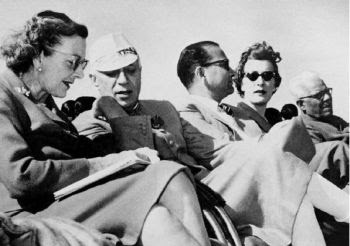
A photo Taken by the legendary Henri Cartier Bresson, this photograph of Mountbatten, Nehru and Edwina - a personal favourite - has been all over of late.

It has been pulled out to accompany reports on Pamela Mountbatten's (Mountbattens' daughter) book published recently `India Remembered: A Personal Account of the Mountbattens During The Transfer of Power.'

Who cares whether Nehru and Edwina's love was platonic or otherwise. How does it really matter to anyone beyond these three people frozen in time. What matters is when you see a man wear just the expression Nehru's wearing - the jester, desperate to catch the woman's eye, trying to impress her, waiting for validation - you will know a man loves a woman.


It was even being said that the knowledge of the more-than-close relationship between Lady Mountbatten and Nehru was in the public domain even in those days and is well documented. It was obvious that Lord Mountbatten was in a position to influence Nehru through his wife. Lady Pamela’s disclosure, therefore, only confirms what many believe. Sardar Patel tried his best to stop Nehru from referring the Kashmir issue to the U.N. but could not do so.


dont forget to read more on the topic published in the frontline.

Sunday, September 30, 2007

DeMockerAcy

Democracy ???
Democracy is widely established as the optimal governance mechanism. This is mainly due to the distribution of power among various institutions (rather than individuals) and the checks and balances against abuse of this power.

But the way the system has managed to beat itself in this game amazes me. If there's anything I've learnt in my diploma institute, its that a system can be adjudged to be a good one only if it does so when all players act in a self-interested ( a sophisticated way of saying 'selfish') manner. Hence I refuse to lay blame on the politicians' door for being selfish. When they find no incentive to lead their respective constituency on the path of development, why would they? When there is an easier and surer way to cling to power than carry out developmental work, why would they care to develop their people?

The least one should expect in a good system of governance is for performance to be linked to rewards/punishment. Instead, there is significant proof that one's misdeeds does not necessarily mean defeat in the next election. Well, we have a live example where a person needs less than 1500 days to make a trillion dollar deficit from a surplus state, gets the energy corporations to decide energy policy and of course, run a war to settle scores with the guy who tried to kill his father, and then win an extra four years to continue his service to his nation. A little before Lok Sabha elections in India this year, India Today reported a survey in which people displayed a remarkably high negative correlation between their preferred candidate choice and his performance.

Political parties seem to consciously avoid issues of importance and would rather debate non-issues. If, in India, it is Mandir / Mandal / Foreign origin etc, in US it is abortion, gay rights, Vietnam War and of course the War on Terror. Whatever happened to good ol' poverty, increasing divide between the wealthy and poor, poor infrastructure etc?!
Even if at a later date, a political party does decide to take up issues of development, by then the public is fixated over the non-issues to the extent that any vote for this new political party will probably be based on its perceived stand on the non-issues.

In other words, the current set of political parties benefit by changing the rules of the game so that the ideal winner is destined to lose.
So what is the way out of this mess? My answer is rather simple - I have no clue whatsoever. I just hope there exists some person who can creatively and intelligently play the game of electoral politics to break this impasse.

Well, the only reason I can think of for democracy to be considered a good system is that every other conceivable system is worse.

In any case, I just hope that out of all this churning will emerge a better system of governance. Hope is good - Andy in Shawshank. Indeed it is.

Tuesday, September 18, 2007

A Poem Agains War - by Leslye Layne Russell

Iraq

dark

dark eyes

dark eyes of the children

say no

say no don't

say no don't do it

again

say no don't do it

say no don't

say no

dark eyes of the children

dark eyes

dark

© January 2003 Leslye Layne RussellThis poem was published in Black Spring Online in 2003 andin Black Spring (print) Winter 2004. It was also published in poets against war in 2003 and was included in the collectiongiven to the White House by Sam Hammill.