Showing posts with label research. Show all posts

Wednesday, September 03, 2008

Manjul Bhargava - Youngest Prof At US Varsity

MUMBAI: It doesn’t take rocket science to figure out that you have a professional hiker by your side.

But when the gentleman you walk with - along the unending stretches at IIT Bombay, Powai - tells you that he arrives at the best solutions to complex mathematical theories while hiking, it makes you pause and wonder.

At 33, Manjul Bhargava is a whiz at maths, music and hiking. And he’s the youngest professor at Princeton University, US. When most people are still learning to navigate the rough and tumble of the workplace, Bhargava had hotfooted it to where he is now.

He did his PhD in number theory at Princeton - he cracked a 200-year-old problem - under his mentor, Andrew Viles. And was named professor at the tender age of 28. “It was weird. I started teaching when I was an undergraduate. And when I went into it full time, I was suddenly flooded with offers from different colleges for various posts.”

Why Princeton? “They had the best offer,” he grins.

But - er - math? A subject that intimidates so many of us mere mortals? To become a reasearcher in that subject, teach it, win prizes and be in love with it is, well, no less than a feat. “Maths is fun. It is a creative process. I always knew I had an inclination for maths. So going into research in the subject was natural for me.”

He believes in the huge potential for the subject in India, and will be teaching at IIT Powai and TIFR in Mumbai for about a month each year.

Bhargava is in India in connection with a string theory conference at TIFR. He also gave a lecture at IIT-B and is working on starting a music programme here. He is an adjunct professor at Princeton and IIT-B, and tries to visit once or twice a year.

“Maths is all about creativity. It’s an art... There is something about Indians that makes them good at maths. It’s either cultural or genetic.” Genetic, maybe. But cultural? “For generations, we have produced great mathematicians. Maybe it’s because of that,” he believes. And, of course, the obsessive importance attached to engineering in the country. “When you’re good at maths, you are immediately pushed towards engineering for economic reasons. Because for a long time, engineers were the ones who grabbed the good jobs.”

However, he feels, things are changing now in favour of pure sciences. “There are a lot more research jobs available. With so many institutes starting up, all the new IITs, they are going to need a lot more faculty.”

But most students dread the M word. That is one exam they will gladly pass up the chance to write. “That is true,” he says. “Sadly, in India, we tend to teach maths according to a structure. Students learn formulae by rote. Teachers should teach maths just like other subjects. Explain a theory, ask students to try and find answers and then guide them in the right direction,” he says.

Another problem, he points out, is that if you are good at any of the sciences, you are expected to choose engineering. “But that’s not the way it works. Someone who excels in maths need not be that good at chemistry or physics. Everyone has a knack for some subject. He or she should be encouraged to concentrate on that subject.”

The levels of teaching the subject here are way ahead of those in the US, he says. “As a child, I used to come down to India for months together. I used to look at textbooks here and wonder. Because the level of maths taught here is way above what their American contemporaries learn at that age.”

Bhargava counts number theory and tabla sessions among his passions. Just like the problems he solves on hikes. He seems pretty much at home walking these roads and talking about his life. Does he do it often? “Oh yes, I do. There are times when I am stuck on a theory and all I need is a long walk in the woods to arrive at a solution. I even take my students on hikes sometimes to explain or work out a theory.”

Maths is, of course, in his blood. His mother too is a mathematics professor. But his horizons have always been broader. “I always knew I was inclined towards maths. At graduation, I took a lot of classes. Even though my core subject was maths, I took credits in Sanksrit, paleontology and economics. Then I started taking classes during my undergrad years and things just kind of fell into place,” he says.

Would he consider moving to India, to share his love for maths? And where would he pitch tent? The answer’s simple. “Mumbai, definitely. It’s where maths and music come together for me,” he says.


Tuesday, September 02, 2008

Study: Heart Bypass Better Than Angioplasty

Study: Heart Bypass Better Than AngioplastyResearchers have said that for patients with difficult-to-treat clogged arteries, a bypass surgery was better than drug stents. Based on the results of a major clinical study by Dutch researchers presented at the European Society of Cardiology meeting in Munich, experts said patients who had angioplasties were twice as likely to require another procedure within a year. Douglas Weaver, president of the American College of Cardiology, said, "Despite the advent of drug-eluting stents surgery comes out a winner."

Doctors have two options when arteries become blocked as a means of treatment. The first is the increasingly popular, angioplasty, a non-surgical procedure where a balloon is pushed into a blood vessel to flatten the blockage, leaving a stent to prop the artery open, while in a bypass surgery, blood vessels are rerouted to detour around blockages. Introduced in the 1990’s, stenting gained popularity as doctors treated patients by inserting a catheter in the groin, a procedure that resulted in quick recovery time and patients are often walking around three days after the procedure. A bypass surgery is more complex and requires open heart surgery, a five hour long procedure under general anesthesia and patients need at least a month to recover fully.

In the study, paid for by Boston Scientific, makers of the drug-coated stent used in the trial, European doctors compared the effectiveness of open-heart surgery versus angioplasty on more than 3,000 patients in Europe and the United States. Patients who had acute heart attacks were excluded while those who had single and multiple vessel blockages were included in the study.

One third of the patients had medical conditions that required surgery while the remaining patients were randomly assigned to receive either surgery or an angioplasty. An average of nearly five stents was needed by patients who got an angioplasty.

One year later 14 % of the angioplasty patients needed a repeat procedure as compared to the 6 % of the surgery patients. Surgery patients had a lower death rate at 3.5 % while it was 4.3 % in the angioplasty patients. On the stroke risk front the surgery patients had a 2 % risk compared to the nearly zero risk for the angioplasty patients as doctors said surgery had an inherent stroke risk as compared to angioplasty.

Dr. Heinz Drexel, professor of medicine at the University of Innsbruck in Austria and spokesman for the European Society of Cardiology said, "If you don't want to have another heart operation for at least a decade, you should pick the surgery. But that means you have to have your chest cracked open.” Drexel was not connected to the research.

A study published in the New England Journal of Medicine found bypass surgery to be preferable for patients who had more than one clogged artery. "Surgery still comes out as the winner in a head-to-head trial," said Dr Weaver. "This comes down to a conversation with patients and making sure they know that with an angioplasty, there will be a higher rate of revascularization," he said, referring to the need for repeat procedures.

Dr. Tim Gardner, president of the American Heart Association said, "You invest more in terms of recuperation with surgery. But the advantage is durability."

Jonathan Halperin of New York's Mount Sinai Medical Center said, "The results of this study are perhaps going to cause cardiologists to pause for a moment and think before they necessarily assume that these are balanced technologies, where one is the equivalent of the other."

Keith Dawkins, Associate Chief Medical Officer at Boston Scientific, said despite not achieving its main goal, the study was reassuring for stent use. He told Reuters, "The primary endpoint was missed. But it wasn't missed because of safety concerns; it was missed due to revascularization.” Revascularization is the repeated need to clear blocked arteries.

Medical experts feel more data and research is needed and patients to be tracked for a longer period of time before it can be decided which is better surgery or angioplasty. "This only tells us what happens after one year," Drexel said. "We need to wait for at least five years to get a good answer about which therapy is really better."


Saturday, August 02, 2008

Musical relativity

Musical relativity

Here’s a neat idea for a concert that’s going to blow a few minds if it ever takes to the stage.


A combination of three or more notes played together is called a chord. We know that certain musical chords sound happy while others sound sad (although nobody knows why). The mood of a piece of music then depends on the combination of chords being played. More than a few weighty tomes have been written about the way one chord can be transformed into another and the effect this has on the mood of the music.

But Kaca Bradonjic, a physicist at Boston University, says that musicians appear to have ignored one of the fundamental ways of changing the pitch of a note: the Doppler shift. He points out that it ought to be possible for an observer moving at a specific velocity to hear a sad sounding note as a happy one and vice versa.

Which means that the mood of a piece of music depends on the relative velocities of the audience and performers.

He calculates for example that to hear a C major chord as a C minor, the listener would need to be travelling at about 43 miles per hour, directly away from the source. That’s a fair speed. And the accelerations necessary to vary this effect from one note to another during a concert would make this one helluva roller coaster ride.

Talking of which, a (very quiet) roller coaster might be the perfect venue for the first concert of this type.

Ref: arxiv.org/abs/0807.2493: Relativity of musical mood

The magnetic magic of liquid mirrors

Liquid mirror


Liquid mirror telescopes are amazing contraptions. They start life as a puddle of mercury in a bowl. Set the whole thing spinning and the mercury spreads out in a thin film up the sides of the bowl.


The result is a fabulously cheap mirror that can be used for a variety of astronomical surveys. If we ever put a telescope on the moon, many astronomers have suggested that it should be one of this type.


It won’t have escaped your attention that liquid mirrors have important limitations. First, they can only point straight up. One or two people have played with fluids that have a higher viscosity than mercury and so can be tilted a few degrees this way or that but with limited success. And second, they cannot be made adaptive to correct for blurring introduced by the Earth’s atmosphere.


But that may change thanks to some interesting work being done by Denis Brousseau at Université Laval in Quebec et amis. Their machine controls the shape of the surface of a liquid mirror using a magnetic field. Mercury cannot be used, however, because it is too dense and changing its shape requires impractically powerful fields.


Instead the team have used a suspension of ferromagnetic nanoparticles in oil. A thin highly reflectivity layer of silver particles can then be spread across the surface of the ferrofluid to create a mirror.


Brousseau and co use an array of tiny coils behind the liquid to create a field that deforms the fluid surface as required. Their tests show this can be done fast and furiously enough to cope with the usual array of optical aberrations that the atmosphere throws up.


However, it may also be possible to use this technique to tilt liquid mirrors further than ever before. Ferrofluids can easily be made much more viscous than mercury and so combat the deforming pull of gravity. But they can also be deformed in a way that opposes gravity during each rotation of the supporting bowl. That could make them much more tiltable than mercury mirrors.


Of course, such a mirror would be mechanically more complex than the spinning bowls we have today and correspondingly more expensive. And sending one to the moon seems an unnecessary extravagance given the absence of an atmosphere there.


But here on Earth they could be made much more useful. It’s a combination of new-found utility and value for money that many astronomy projects on a budget will find irresistible.


Ref: arxiv.org/abs/0807.2397: Wavefront Correction with a Ferrofluid Deformable Mirror: Experimental Results and Recent Developments

Source: arxivblog.com

Thursday, May 08, 2008

Qutrit breakthrough brings quantum computers closer

Toffoli gate

The folks playing with quantum computers have been claiming for years that their gadgets will one day make today’s supercomputers look like quivering lumps of jelly. But so far, their computers have yet to match the calculating prowess of a 10-year old with ADHD.

The most exciting work so far has been on universal quantum logic gates, the building blocks of any computer. A number of groups have built and demonstrated these and one team even took their gates for the computing equivalent of a run round the block by factorising the number 15.

The trouble is that, to do anything useful with universal quantum gates, you need at least dozens and preferably hundreds of them, all joined together. And because of various errors and problems that creep in, that’s more or less impossible with today’s technology.

Which is why a breakthrough by an Australian group led by Andrew White at the University of Queensland is so exciting. They have built and tested quantum logic gates that are vastly more powerful than those that have gone before by exploiting the higher dimensions available in in quantum mechanics. For example, a qubit can be encoded in a photon’s polarisation. But a photon has other dimensions which can also be used to carry information, such as its arrival time, photon number or frequency. By exploiting these, a photon can easily be used as a much more powerful three level system called a qutrit.

This is how the Ozzie team have exploited the idea: during a computation, their gates convert qubits into qutrits, process the quantum information in this more powerful form and then convert it back into qubits. All using plain old vanilla optics.

That allows a dramatic reduction in the number of gates necessary to perform a specific task. Using only three of the higher dimension logic gates, the team has built and tested a Toffoli logic gate that could only have been constructed using 6 conventional logic gates. And they say that a computer made up of 50 conventional quantum logic gates could be built using only 9 of theirs.

That’s a significant reduction. What’s more, they reckon that these kinds of numbers are possible with today’s linear optics technology.

That means these guys are right now bent over an optical bench with screwdrivers and lens cloths at the ready, attempting to build the world’s most powerful quantum computer. We may see the results–a decent factorisation perhaps–within months.

Could it be that Australia is about to become the center of the quantum computing world?

Ref: arxiv.org/abs/0804.0272: Quantum Computing using Shortcuts through Higher Dimensions

Global warming: we have 10 years to avoid catastrophe

Global warming

The arxiv isn’t usually the place where climate scientists make predictions about global warming but yesterday, they made an exception. A group led by James Hansen, one of the world’s leading climate scientists who works at NASA’s Goddard Institute for Space Sciences, warned that global warming is having much worse effects on Earth’s climate than thought. They say without immediate action, humanity is in danger of “seeding irreversible catastrophic effects.”

The background, in case you’ve been stuck on a desert island for the last few years, is that CO2 levels in the atmosphere have doubled from 180 ppm in pre-glacial times to 385 ppm today, most which has come since the industrial age began. “Humanity today, collectively, must face the uncomfortable fact that industrial civilization itself has become the principal driver of global climate,” says Hansen and co.

So what to do? The International Panel on Climate Change suggests that global warming of more than 2-3 degrees C may be dangerous, the EU says we should attempt to limit global warming to no more than 2 degrees C while Hansen himself has said that 1 degree C should be the maximum we should tolerate. This last estimate implies a maximum level of CO2 of 450ppm.

Now Hansen says he was wrong and that we need to aim for a CO2 level of only 350 ppm to be sure of maintaining the climate in the state we’re used to. Because if we carry on as we are, the world is going to change in ways that hard to imagine. I’ll let Hansen do the rest of the talking:

“Present policies, with continued construction of coal-fired power plants without CO2 capture, suggest that decision-makers do not appreciate the gravity of the situation. We must begin to move now toward the era beyond fossil fuels. Continued growth of greenhouse gas emissions, for just another decade, practically eliminates the possibility of near-term return of atmospheric composition beneath the tipping level for catastrophic effects.”

Frightening stuff.

Ref: arxiv.org/abs/0804.1126: Target Atmospheric CO2: Where Should Humanity Aim?

Ref: arxiv.org/abs/0804.1135: Supporting Material

Wednesday, May 07, 2008

Nanoclusters break superconductivity record

Al nanoclusters

Wow! Every now and again a paper on the arxiv leaps out at you and today there’s work from Indiana University in Bloomington that has got my eyeballs on stalks.

Get this: a team led by Martin Jarrold is claiming to have found evidence of superconductivity in aluminium nanoclusters at 200 K .

Yep, 200 K. The current world record for high temperature superconductivity is 138 K for a cuprate perovskite so that’s a massive jump.

The background to this is that two years ago Yuri Ovchinnikov at the Landau Institute for Theoretical Physics in Moscow and Vladimir Kresin at the Lawrence Berkeley Laboratory in California predicted that metal nanoclusters with exactly the right number of delocalised electrons (a few hundred or so) could become strong superconductors.

Now Jarrold and his buddies (Kresin and Ovchinnikov among them) have found the first evidence that this prediction is correct in individual aluminium nanoclusters containing 45 or 47 atoms . And they found it at 200 K.

A few caveats. Before a claim of superconductivity can be made, physicists require three unambiguous and repeatable lines of evidence. The first is obviously zero electrical resistance. The second is the Meisner effect in which the superconductor reflects an external magnetic field. And finally there must be evidence of a superconducting phase transition, such as a jump in the material’s heat capacity when superconductivity occurs.

What Jarrold’s team have measured is the last effect–a massive change in an individual nanocluster’s heat capacity at 200 K. That’s an important pillar of evidence which is consistent with superconductivity but it is not yet a slam dunk.

Jarrold and his team are simply time-stamping their efforts by publishing on the arxiv and you can bet your bottom dollar that they’re looking for other evidence right now.

Even with that proviso, this looks to be an important breakthrough which should be straightforward for other groups to replicate. The group’s work is not yet peer-reviewed. That’ll be an important step too.

Jarrold will be only too mindful that the field of high temperature superconductivity is littered with the corpses of physicists who have made premature claims.

But for the moment, sit back and admire. 200K…wow! That’s room temperature in Siberia at certain times of the year.

Ref: arxiv.org/abs/0804.0824: Evidence for High Tc Superconducting Transitions in Isolated Al45 and Al47 Nanoclusters

Earlier ref: arxiv.org/abs/cond-mat/0603733: Shell Structure and Strengthening of Superconducting Pair Correlation in Nanoclusters

Bluetooth surveillance secretly tested in the city of Bath

Bath according to bluetooth

In 2001 Jose Emilio Suarez Trashorras was jailed in a Spanish prison for drug related offences. Whilst imprisoned, Trashorras established regular contact with Jamal Ahmidan who was serving time for a petty crime. Both individuals embraced radical Islamic fundamentalist ideas within the prison and were recruited in the Takfir wa al-Hijra group, a Moroccan terrorist groups linked with al-Qaida . Following their release, Ahmidan became the leader of the terrorist cell that conducted the Madrid bombing. In a drugs-for-bombs exchange with a third party, Trashorras provided the explosives for the 13 backpack bombs that killed 191 people and injured hundreds.

So write Vassilis and Panos Kostakos in the department of computer science and the University of Bath in the UK, who have come up with a system that they say could spot and monitor these kinds of interactions in prisons.

Their idea? Fit inmates with RFID tags that allow their positions to be monitored, and then number crunch the resulting data sets to see who spends the most time with whom.

Not exactly rocket science but the Kostakos’s have an even more frightening idea. Why not test the idea by anonymously monitoring the movements of students, residents and workers of the city of Bath by listening out for their bluetooth-enabled devices as they move around the city. And that’s what they’ve done.

What the Kostakos found is that it is straightforward to capture data on people’s encounters using bluetooth. In fact they captured data on 10,000 unique devices during the 6 month study. Yep, that’s 10,000.

Exactly how much you can tell about these encounters isn’t clear. But hey, this is only a demonstration (either that or they’re keeping schtum about the juicy details).

Of course, it’s already possible to make inferences about encounters between individuals using the location information from cellphone networks. But that isn’t easily accessible to ordinary folk and in any case has a blunt resolution of a mile or so. Bluetooth, on the other hand, gives your location to within 10 metres or so.

The moral? Turn off your bluetooth enabled devices when in the city of Bath (and anywhere else). In other hands, this kind of data could be dangerous.

Ref: arxiv.org/abs/0804.3064: Intelligence Gathering by Capturing the Social Processes Within Prisons

The puzzling discovery of a motor made from liquid film

Liquid film motor

Here’s an interesting effect discovered by a group of Iranian physicists at Sharif University of Technology in Tehran, Iran (it’s not often we hear from these guys).

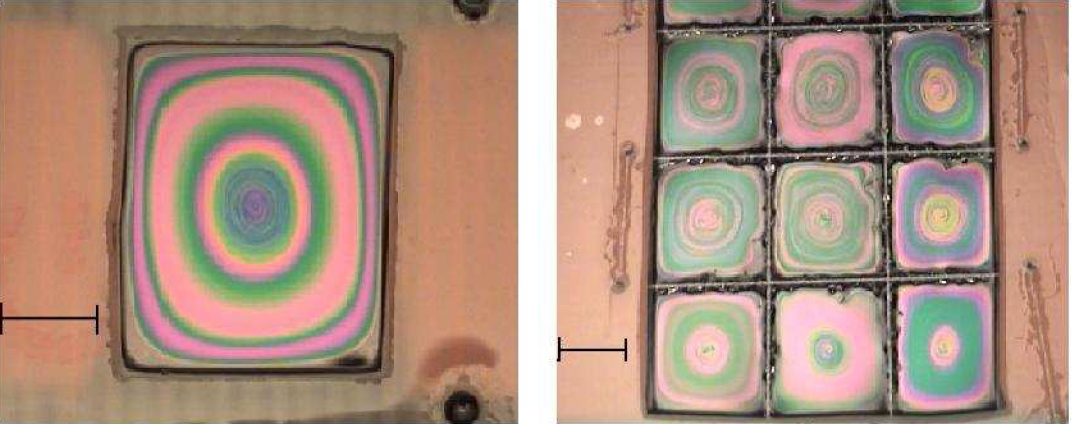
They placed a thin film of water in a square cell and applied two perpendicular electric fields. One was an external electric field. For the other, they used two copper electrodes to generate a voltage across the cell like an electrolysing cell (although no chemical reaction took place).

So they had a pair of electric fields at right angles acting on this thin film.

The unexpected result is that the film of water begins to rotate. The team has a number of movies of the effect on its website. They call it a liquid film motor and it’s a quite extraordinary effect. At one point they divide their cell into nine smaller ones and the liquid in each cell rotates in exactly the same way.

The question is: what’s causing the rotation? The team can easily control the direction and speed of rotation by varying the relative angle and direction of the electric fields, which rules out the possibility that convection is causing the rotation (something that is seen when a field is applied to some thin films of liquid crystals). Neither does adding salt to water change the effect, ruling out the possibility that ion movement directs the flow.

The rotation occurs in polar liquids but not in non-polar ones so the intrinsic dipole moment of the molecules seems to be crucial. People have been observing the electrohydrodynamics of various types of thin films for a good few years but nobody has seen anything like this. Just what’s going on remains a mystery.

But the puzzle shouldn’t overshadow what looks like an important discovery that could have widespread industrial application in microfluidic devices for mixing.

Ref: arxiv.org/abs/0805.0490: A Liquid Film Motor


Wednesday, April 02, 2008

Calling All Mad Scientists - to stop Global Warming...

To stop global warming we may need to start thinking outside the box


In the summer of 1858, a putrid odor of raw sewage arose from the River Thames in London and choked the city in its sickly grip. The Great Stink, as it came to be known, spurred Britain's lawmakers to rush a bill through Parliament to provide the money to build a modern sewer system -- one that would discharge sewage downstream from the river's drinking water intake. Construction of similar structures in the same era in a number of European and American cities, including Paris and Chicago, ended epidemics of typhoid and cholera, which victims contracted by drinking water contaminated with feces. If the Victorians could eliminate these diseases through careful disposal of human waste, why can't we counter climate change by extracting carbon dioxide from the atmosphere and burying it where it can do us no harm?


That radical proposal lies at the core of Fixing Climate, the latest in a spate of books on the seemingly intractable problem of global warming. While most writers stress the need to cut greenhouse gas emissions, the authors of Fixing Climate -- Columbia University earth scientist Wallace Broecker and the science writer Robert Kunzig -- suggest instead that we view carbon dioxide as a form of sewage: a pollutant with which we have carelessly contaminated the atmosphere, but one that we can remove with the right technology. Doing so is necessary, they argue, because the chance that we will succeed in paring back our carbon emissions with the speed required to avert disaster is quite small.


Broecker and Kunzig embrace a techno-fix that would require us to scrub our carbon dioxide waste from the atmosphere and sock it away in rocks. Their proposal is typically American: upbeat in its can-do spirit, yet pragmatic. The pair are not breast-beating penitents. In fact, they open their book with an eloquent ode to the beauty of the piston engine, acknowledging that fossil fuels have enabled the average American to live as well as a preindustrial king. Yet it's time to shovel away the scum. "We need to create the means for taking our carbon back out of the air and putting it underground, where it came from," they write.


If anyone should be taken seriously on the topic of climate change, it is Wallace Broecker, who has spent more than 50 years studying the climate of the past 200,000 years, and who was one of the first to warn, more than three decades ago, of the dangers of global warming. Born in 1931 ("the same year as Twinkies," the book points out), he arrived in 1952 at what is now Columbia University's Lamont-Doherty Earth Observatory in Palisades, New York. He has spent his entire career there, publishing more than 400 papers and winning numerous prizes, including the National Medal of Science. Over the years, Broecker has developed ways to calculate the rate of gas exchange between the atmosphere and the ocean -- in particular, oceanic uptake of carbon dioxide -- and devised what is known as Broecker's Conveyor Belt, a global scheme of ocean circulation that is thought to drive climate patterns the world over.


As background to their proposal, Broecker and Kunzig devote about a third of their book to explaining the complex history of climate change science; a laudable effort, though at times my eyelids did begin to droop. To their credit, they enliven the text with asides on the notable figures who first figured out the science at hand (among them the Swedish physicist Svante Arrhenius, whose "ravishing young wife, Sophia" deserted him in 1894 after a year of marriage in the midst of his calculations on planet-warming carbon dioxide).


The book's real focus, though, is a climate fix hatched by Klaus Lackner, now a physicist at the Earth Institute at Columbia University. Lackner's company, Global Research Technologies, announced in the spring of 2007 that it had built a prototype "air-capture technology product" to suck CO2 out of the atmosphere. When Broecker first heard Lackner talking about his ideas in 1999, he recalled thinking, "This guy is nuts." Lackner, then an associate director of Los Alamos National Laboratory, argued that we should attempt to accelerate the natural chemical breakdown of rocks. The plan: grind up billions of tons of magnesium- or calcium-rich rocks, chemically combine them with carbon dioxide to form another type of rock -- a harmless carbonate -- and then find a place to put the resulting mountains of the stuff. Later on, Broecker found Lackner's tendency to think big-and his willingness to attack a problem from first principles -- "more exciting than crazy," and lured him to Columbia.


In fact, there is nothing all that revolutionary about pulling carbon dioxide out of the air; it is done on every space shuttle and submarine to prevent crews from asphyxiating on their own exhaled breath. Lackner built his prototype on a budget of $5 million from the late Gary Comer, the founder of Lands' End. In this device, crushed rocks have been replaced by a plastic compound that reacts with CO2 to form sodium bicarbonate: essentially, baking soda. If Lackner's vision comes to fruition, 20-foot-tall carbon-sucking towers-each resembling an erect Tower of Pisa-could be arrayed all over the planet. The final step in this massive cleanup project would be to extract CO2 from the bicarbonate and inject it into the ground in liquid form.

Each tower would extract about one ton of carbon dioxide a day, so it would take an awful lot of towers to scrub the 80 million tons we emit daily. The sheer scale of the problem dwarfs any single solution, but in Broecker and Kunzig's view, Lackner's invention is "the only hope." Their reasoning is simple: the towers can be placed anywhere -- far easier and more practical than attaching a CO2 scrubber to every car and airplane on the planet. And because CO2 disperses quickly through the entire atmosphere, removing it in one spot helps the whole world.


By contrast, say Broecker and Kunzig, collecting CO2 from the flues of power plants would entail transporting the gas perhaps hundreds of miles to a dumping ground. Nevertheless, this too promises to be an important means for steering us from the path of doom, should we manage to make it happen. In January, the Department of Energy scrapped plans for FutureGen, a coal-fired plant that was to collect and dispose of its own CO2 emissions.


The Norwegian oil company Statoil currently captures CO2 from its drilling operations at the Sleipner natural gas field in the North Sea, and it then injects a million tons of the gas each year under the seabed. There are plenty of other places to put the heat-trapping gas. Iceland, for example, is made entirely of basalt, a volcanic rock rich in calcium silicates, which bind with CO2. This fall, Reykjavik Energy plans to begin pumping carbon dioxide half a mile deep into basalt deposits. Vast banks of basalt also exist elsewhere: in the United States, volcanic rock covers more than 60,000 square miles of Washington, Idaho, and Oregon.


Detractors will inevitably dub such schemes misguided or deluded. Tim Flannery, for one, argues in his 2005 book, The Weather Makers, that the volume of carbon dioxide we create is "so prodigious that it seems impossible for Earth to tuck it away without suffering fatal indigestion." The authors of Fixing Climate are not oblivious to the scale of the problem or the expense of the solution. If we choose Lackner's original proposal, then large mounds of carbonate must be piled or buried somewhere. That would transform the landscape, but so would covering hundreds of square miles with solar panels. "There is no free lunch in solving the CO2 problem," Broecker and Kunzig say.


As for Lackner's current proposal to array carbon-capturing towers across the globe, they admit that it sounds utopian. "If the amount [of CO2] the world produced in a single year were spread over Manhattan, it would rise three-quarters of the way up the Empire State Building. On the other hand, if all the wastewater produced in the United States alone were spread over Manhattan, even the radio antenna on top of the Empire State would be far beneath the waves. Yet somehow in the twentieth century we managed to get our sewage problem under control." With our own Great Stink now threatening to overpower the entire planet, we owe it to ourselves and our descendants to consider the merits of such ambitious technological fixes before we suffocate in our own stifling waste.

Monday, March 31, 2008

Strike power - Indias remarkable feat in achieving the Triad status...


The successful launch of Sagarika, or K-15, demonstrates India’s submarine-to-surface missile capabilities.

IN missile technology, the Defence Research and Development Organisation (DRDO) has arrived. In the past few months, it has had a phenomenal run of success with its various missiles, and it proved on February 26 that it had acquired the capability to launch ballistic missiles from under the sea. On that day, a ballistic missile named Sagarika, or K-15, blasted off flawlessly from a pontoon submerged to a depth of 50 metres in the Bay of Bengal off the coast of Visakhapatnam, Andhra Pradesh. It knifed upwards as the water around it sizzled, rose into the sky, traced a parabola, and reached its full range, a point more than 700 kilometres away. The pontoon simulated the conditions of a submarine.

India thus joins the select club of countries, which includes Russia, the United States, France, China and the United Kingdom, with submarine launch capabilities. What affirmed India’s entry into this league was that this was the fifth launch of the Sagarika missile from a submerged pontoon and, according to DRDO missile technologists, all the five were “consistently successful”. While the previous four launches were kept a secret, the DRDO did not fight shy of revealing the launch date of the fifth mission. Sagarika is a submarine-to-surface ballistic missile that can carry nuclear warheads.

The top brass of the DRDO and the Navy monitoring the missile’s flight from a naval vessel included M. Natarajan, DRDO chief and Scientific Adviser to the Defence Minister; A.K. Chakrabarti, Project Director, who belongs to the Defence Research and Development Laboratory (DRDL), Hyderabad; and Prahlada, Chief Controller, R&D, DRDO. A top DRDO official called it an “excellent mission and a copybook flight”. Another missile technologist called it “a thumping success”.
The successful launch takes India closer to its plan of completing the triad, that is, the launching of missiles with nuclear warheads from sea, land and air, as part of establishing a credible, minimum nuclear deterrence. India has already acquired the capability of launching nuclear-tipped missiles from the ground (that is, surface-to-surface missiles) with its Agni-II, Agni-I and Agni-III types of missiles and its Prithvi-I and Prithvi-II missile variants. The Indian Air Force’s Mirage and Sukhoi-M30 fighter aircraft are capable of delivering nuclear weapons. “It is a great day for the country’s missile technology and national defence capability,” said a missile technologist. “We are getting into the possibility of completing the triad. This successful launch will give us the sea capability.”

If things go as planned, in about two years India will launch the Sagarika missile from a submarine reconfigured for the purpose and later from the nuclear-powered submarine that is being built at Visakhapatnam and at Kalpakkam, Tamil Nadu. The indigenous nuclear-powered submarine project is called Advanced Technology Vessel (ATV), and the partners in that programme are the DRDO, the Navy and the Bhabha Atomic Research Centre (BARC) of the Department of Atomic Energy (DAE).

Admiral Sureesh Mehta, the Chief of the Naval Staff, said in December 2007 that the ATV would be ready for sea trials in two years. It was the first time that a top-ranking official had gone on record about the highly classified ATV project. The Agence France-Presse (AFP) quoted Mehta as saying: “Our scientists have confirmed that they would have the Advanced Technology Vessel project ready for trials by 2009…. Placing of nuclear weapons under the sea is the third [leg of the] triad, which at present we don’t have and we hope at one point we will.”

Sagarika is a product of the DRDO’s missile complex at Hyderabad. The missile complex consists of the DRDL, the Advanced Systems Laboratory (ASL) which is headed by Avinash Chander, and the Research Center Imarat (RCI). Sagarika is a versatile missile that can be launched from different platforms: from submarines, from the ground and from mobile launchers. It is about 6.5 m long and weighs about 7 tonnes. It can carry nuclear warheads weighing up to 600 kg. According to another version, it is 10 m long. It is a single-stage missile powered by solid propellants. DRDO officials describe it as “light and short”. It was miniaturised and canisterised. It has advanced avionics, propulsion, control and guidance, and inertial navigation systems. While its underwater booster propels it out of the water, its powerful air booster fires and can take it over a distance of more than 700 km.

On the launch day, there was no one aboard the pontoon when the missile was fired. A naval ship was positioned several kilometres away, and the missile’s fire-control systems were in place on this ship, which was linked to the pontoon by an underwater cable and through wireless communication. So the test-firing was a remote operation. Several naval vessels were in position to track Sagarika’s trajectory. The Integrated Test Range had moved some of its equipment from Balasore to Visakhapatnam to track the missile.

The DRDL designed and developed Sagarika and the ASL contributed to its propulsion systems, including its powerful motors. The RCI contributed to its avionics, including control and guidance and inertial navigation systems. Sagarika is similar to Agni-I, which is also a single-stage missile powered by solid propellants and with a range of 700 km.

The mood is upbeat in the missile complex because Sagarika’s success closely follows India’s demonstration of its capability to defend itself against ballistic missile attacks. India fired a hypersonic interceptor missile that intercepted and destroyed an incoming target missile in a direct hit over the Bay of Bengal on December 6, 2007. The interception took place at an altitude of 15 km, in what is called the “endo-atmosphere”. What was outstanding about that mission was that it was a “hit to kill”. The success gave India an entry into the club comprising Russia, the U.S. and Israel, all of whom have missiles that can block incoming ballistic missiles.

In November 2006, India demonstrated its air defence capabilities against incoming ballistic missiles when it shot down an “enemy” missile in the exo-atmosphere, that is, 50 km above the earth. That too was a hit-to-kill mission. In April 2007, the DRDO successfully fired its Agni-III missile, which has a range of more than 3,500 km and can carry nuclear warheads weighing 1 tonne. Akash, the surface-to-air missile, underwent a series of “drills” in December 2007, and the IAF was pleased with its performance.

On February 22, four days before the Sagarika launch, former President A.P.J. Abdul Kalam, one of the architects of India’s missile programme and the founder of the RCI, pointed out that India had conducted two tests of interceptor missiles in the exo-atmosphere and endo-atmosphere.

“From the results of their performance, I can say we really have the capability” to intercept any foreign object at an altitude of 200 km, he said. “Of course, they [the DRDO] have to do more tests. They have definitely arrived. Their technology is reliable,” Kalam added. He was speaking to reporters at the RCI on the sidelines of an international conference on “Avionics systems”. He made this observation in response to a question on the U.S. launching a missile from a naval vessel on February 21 to destroy a non-functioning satellite about 247 km above the Pacific Ocean. Dr. V.K. Saraswat, Chief Controller (Missiles and Strategic Systems), DRDO, chipped in to say that India had the capability to destroy both an adversarial missile and a wayward satellite. “We have the technological strength to obstruct and destroy them,” he said.

As far as India’s missile programme was concerned, Saraswat said, the Agni-II and Agni-I ballistic missiles were already in the inventory of the armed forces. There have been two flights of Agni-III. India will soon go in for “the next level of Agni-III flight”. Akash was ready for induction into the IAF. The process of its production was under way.

Thursday, March 27, 2008

Black carbon contributes more in global warming: study

New York (PTI) : Black carbon, emitted from biomass burning, diesel engine exhaust and cooking fires -- widely used in India and China -- has a warming effect in the atmosphere three to four times greater than prevailing estimates, according to scientists.
In an upcoming article in the journal Nature Geoscience, Scripps Climate and Atmospheric Science Professor V Ramanathan and University of Iowa researcher Greg Carmichael presented their findings on the global warming effect that the soot and other forms of black carbon could have.
Between 25 and 35 per cent of black carbon comes from India and China, emitted from the burning of wood and cow dung in household cooking and through the use of coal to heat homes, it says.

Soot and other forms of black carbon could have as much as 60 per cent of the current global warming effect of carbon dioxide, the leading greenhouse gas, the researchers noted.

Per capita emissions of black carbon from the United States and some European countries are still comparable to those from south and east Asia, the paper says.

In the paper, Ramanathan and Carmichael integrated observed data from satellites, aircraft and surface instruments about the warming effect of black carbon.

They found that its warming effect in the atmosphere, is about 0.9 watts per metre squared (W/m-2), compared to estimates of between 0.2 W/m-2 and 0.4 W/m-2 that were agreed upon as a consensus estimate in a report released last year by the Intergovernmental Panel on Climate Change (IPCC).