எண்ணிய முடிதல் வேண்டும்
நல்லவே என்னல் வேண்டும்
திண்ணிய நெஞ்சம் வேண்டும்
தெளிந்த நல்லிரவு வேண்டும்
பண்ணிய பாவமெல்லாம்
பரிதிமுன் பண்ணியபோல
நண்ணிய நின்முன் இங்கு
நசிந்திட வேண்டும் அன்னையே
Should all my wishes be fulfilled
Should I wish only that is good!
Should I possess a heart that is strong
So should I acquire a knowledge devoid of doubts
All my sins
like the mist before the sun
In your graceful presence here
டிசப்per should all they be! O! Mother!
Friday, May 30, 2008


Don't Give Up !! The more you take in the more you are shaped up !!!
There was this museum laid with beautiful marble tiles, with a huge marble statue displayed in the middle of the lobby. Many people came from all over the world just to admire this beautiful marble statue.
One night, the marble tiles started talking to the marble statue. Marble tile: "Marble statue, it's just not fair, it's just not fair! why does everybody from all over the world come all the way here just to step on me while admiring you? Not fair!".
Marble statue: "My dear friend, marble tile. Do you still remember that we were actually from the same cave?"
Marble tile: "Yeah! That's why I feel it is even more unfair. We were born from the same cave and yet we receive different treatment now. Not fair!" he cried again.
Marble statue: "Then, do you still remember the day when the designer tried to work on you, but you resisted the tools?"
Marble tile: "Yes, of course I remember. I hate that guy! How could he use those tools on me, it hurt so badly.".
Marble statue: "That's right! He couldn't work on you at all as you resisted being worked on."
Marble tile: "So???"
Marble statue: "When he decided to give up on you and start working on me instead, I knew at once that I would be something different after his efforts. I did not resist his tools, instead I bore all the painful tools he used on me.."
Marble tile: "Mmmmmm......."
Marble statue: "My friend, there is a price to everything in life. Since you decided to give up half way, you can't blame anybody who steps on you now."
One night, the marble tiles started talking to the marble statue. Marble tile: "Marble statue, it's just not fair, it's just not fair! why does everybody from all over the world come all the way here just to step on me while admiring you? Not fair!".
Marble statue: "My dear friend, marble tile. Do you still remember that we were actually from the same cave?"
Marble tile: "Yeah! That's why I feel it is even more unfair. We were born from the same cave and yet we receive different treatment now. Not fair!" he cried again.
Marble statue: "Then, do you still remember the day when the designer tried to work on you, but you resisted the tools?"
Marble tile: "Yes, of course I remember. I hate that guy! How could he use those tools on me, it hurt so badly.".
Marble statue: "That's right! He couldn't work on you at all as you resisted being worked on."
Marble tile: "So???"
Marble statue: "When he decided to give up on you and start working on me instead, I knew at once that I would be something different after his efforts. I did not resist his tools, instead I bore all the painful tools he used on me.."
Marble tile: "Mmmmmm......."
Marble statue: "My friend, there is a price to everything in life. Since you decided to give up half way, you can't blame anybody who steps on you now."
If you can't hop out, keep swimming around!
Two frogs fell into a deep cream bowl.
One was an optimistic soul.
But the other took the gloomy view.
"We'll drown," he lamented without much ado,
and with a last despairing cry,
he flung up his legs and said "Goodbye."
Quote the other frog with a steadfast grin,
"I can't get out but I won't give in,
I'll just swim around till my strength is spent,
then I'll die the more content."
Bravely he swam to work his scheme,
and his struggles began to churn the cream.
The more he swam, his legs a flutter,
the more the cream turned into butter.
On top of the butter at last he stopped,
and out of the bowl he gaily hopped.
What is the moral? It's easily found...
If you can't hop out, keep swimming around!
One was an optimistic soul.
But the other took the gloomy view.
"We'll drown," he lamented without much ado,
and with a last despairing cry,
he flung up his legs and said "Goodbye."
Quote the other frog with a steadfast grin,
"I can't get out but I won't give in,
I'll just swim around till my strength is spent,
then I'll die the more content."
Bravely he swam to work his scheme,
and his struggles began to churn the cream.
The more he swam, his legs a flutter,
the more the cream turned into butter.
On top of the butter at last he stopped,
and out of the bowl he gaily hopped.
What is the moral? It's easily found...
If you can't hop out, keep swimming around!
Thursday, May 29, 2008
How Gilchrist's squash-ball trick has helped Venugopal Rao get going

Adam Gilchrist's brutal century against Sri Lanka in the 2007 World Cup final - an innings that single-handedly won Australia the trophy and restored his image as one of the most destructive opening batsman the world has ever seen - will remain etched in the memory for a long time.
The fact that the innings ran into a brief controversy after the wicket-keeper-batsmen had used a squash ball in his left glove tends to get forgotten. The Sri Lankan team had lodged a complaint, but the International Cricket Council had cleared the batsman.
Now, in his stint with the IPL's Hyderabad team Deccan Chargers, Gilchrist has not only used the little squash ball for his own batting exploits, but has also advised the rest of his team members on the advantages of doing so. When his team mates in Hyderabad had asked him to explain the use of the ball, he said "it provides me with a better grip."
Among those who listened to what Gilchrist had to say, only Venugopal Rao decided to try it out. Whether it's a direct co-relation or not, the right-hander from Andhra Pradesh has managed an impressive 242 runs in nine IPL innings at an overall strike rate of 147.56 and is the team's third-highest scorer after Rohit Sharma and Gilchrist.
Rao's exploits in IPL have taken bowlers by surprise. Not known as a batsman who strikes the ball hard and clean, Rao has hit 14 sixes and 19 boundaries in the tournament so far, taking Hyderabad agonisingly close to victory from hopeless situations in two games.
"I am using the ball in my right glove. It gives me the advantage of a better grip. I took Gilchrist's advice and it's actually working well," Rao told The Indian Express.
Big impact
Rao says he'll continue using the squash ball as long as he's comfortable with it. In the match against Delhi at the Ferozeshah Kotla last week, Rao's 34 off 18 balls contained two sixes and three fours - and one six in particular, off Farveez Maharoof over long-on, was an example of Rao's comfort factor with the squash ball in his glove. The shot was played as late as possible and close to his body and the timing, says Rao, is reflective of the grip he enjoyed.
While none of the other members have made use of the golf ball yet, New Zealand's Scott Styris, who has witnessed the change in Rao's batting, is now trying to experiment with it himself.
Reacting to the Lankan team's complaint after the World Cup final, the ICC has legalised the use of a ball saying "it is not against the laws or the spirit of the game".
"Since there is no restriction in law even on the external form of batting gloves, let alone the interior thereof, no law has been breached," the ICC said.
In fact, the ICC representative had said at the time: "It's been suggested that if shoving a squash ball into your bottom glove makes you bat like Adam Gilchrist, then perhaps the ICC should make it compulsory".
Looking at the way Rao's batting, that day may not be too far away.
what is DEATH and what happens aftermath ?? - a scientific vantage point...
At times i keep wondering myself about death. What is death? What happens when we die? Do we enter a different world aftermath ?
There are many theories that tell there is nothing after death..... Maybe death is just a machine fails to run and all the organs just stops..... all the memories and feelings lies no further.... But the fact still remains that these are just assumptions without any proof .
But what about those whose tell about NDE's (Near Death Experience). Are they just fake or some kind of illusion ceated by Human brain What exactly happens after death. What happens to our memories? Is it similar to destroying the hard disk of a computer?
One of my friend said hey none of them can say after death wat happens??? as much as science is concern but according to religion they have diff beliefs and if sum one who belives in god can belive in these things and their r many books which co relate wat happens after death but most of them i had read r with out proof .
And then i somehow reasoned to myself Or may be life is just a form of energy present in this universe and when someone dies, this energy beomes a part of the net energy of the universe because what ever that is present in the universe is in the form of Mass-Energy. Mass occupied by that person is somehow converted into energy and then it becomes a part of this universe.
Maybe yes when we are eaten by worms and our mass is utilized as energy by worms and then it travels the whole universe by changing from one form to another.
Having said that, dont think of afterlife stories and heaven n hell it's ofcourse not you who is travelling, face it man! you are dead! which means DEAD. No, dont think of stories to reconcile you of a beautiful heaven, with 72 Virgins waiting for you.
Here I am talking about energy not about myself. There is no life after deathits all an illusion of mind for example an Englishman will see a Satan speaking english in his dreams while an indian (hindu to be more precise) will see a yamraj speakin hindi or sanskrit its all a trick of mind... get well oh man...
Feeling Sick? Stay Home
Courtesy: shiftingcareers
Last week, one of my New York Times colleagues canceled a lunch meeting because he was sick and wanted to go home to rest. It was a Friday, and it was raining heavily outside. Even though I was looking forward to that meeting, I was delighted. His canceling meant that I didn’t have to leave my apartment. (I work from home.) And I also wouldn’t be at risk of catching his cold.
I don’t know why more people don’t do this. Instead, as winter moves along, many of us are surrounded by sick co-workers who show up in the office, at lunches and at meetings, determined (or so it seems) to infect the rest of us. This behavior is so prevalent that it now has an official name, “presenteeism,” and it costs companies a lot of money because it makes other people sick. The good news is that some companies have started to recognize the high cost of presenteeism and encourage sick employees to stay home and rest (or work from home if they are up to it).
I recognize that some employers may not be enlightened enough to embrace this way of thinking, and that some people don’t have enough sick days or feel secure enough in their jobs to stay home even when they are sick. But here are a few reasons why you should stay home if you can.
We all know that you can often accomplish more work in a few hours at home with no interruptions than in eight hours in the office. If you have the flexibility to work from home, then days when you are brewing a cold or dealing with a full-blown one are the ideal time to practice your telecommuting skills.
Since people are most contagious in the first two or three days of a cold, you will help your whole organization by not getting your colleagues sick.
Putting aside those who are legitimately fearful of losing their jobs, the people who show up while sick tend to be the ones so arrogant that they think work cannot go on without their presence. You don’t want to be one of those. (If this sounds like someone you know, you may want to print out this post and leave it anonymously where that person can find it.)
If you rest, you will probably get well faster. So by taking some time off, you will probably improve your overall productivity.
In these days of meeting overload, you will probably make someone very happy if your absence means that a meeting has to be canceled.
As for my colleague, we rescheduled our lunch for the following Friday. When I saw him, he said that his cold turned out to be not so bad after all. Perhaps he nipped it in the bud by going home early. Most important, he didn’t get me sick. My opinion of him (already pretty high) is ever so higher.
Friday, May 23, 2008
Inflation a comparison as Zimbabwe breaks all records!
Inflation breaks all the records in Zimbabwe. But it's a wonder how at this inflation-level, its economy is still surviving, the country has observed election and Robert Mugabe has lost, but still not very large scale of violence has been reported!
OUR government, along with Reserve Bank of India (RBI), worries about the effect of nearing eight per cent inflation in our country. But if we see inflation data of few other countries and observe that still those economies are surviving, then we will realise that chances are that we may say, “Hey we are very comfortable as far as inflation is concerned.” There are a number of countries that are having inflation rate much more than ours, but still those economies are alive.
Inflation in Zimbabwe has broken all the records and is first such country of the list where inflation has reached to an uncountable percentage. Name of Zimbabwe will probably appear in the Guinness Book of World Records. In March 2008, inflation was 3,55,000 per cent, which was the double of the inflation in February 2008, when it was 1, 65,000 per cent. We have to say thanks to the Country’s Central Bank (CCB) and the people who are involved in inflation calculation. How they are able to calculate the 3, 55,000 per cent inflation is out of the intelligence of normal people.
What does this level of inflation in Zimbabwe mean to the poor residents of the country? It means that Zimbabweans are purchasing a sandwich for Zimbabwean $50 million, sounds crazy? One kg of potatoes cost Zimbabwean $17 million. Effectively, this means that the value of Zimbabwean dollar has reached almost to zero. Hence 50-million Zimbabwean dollar equals to only1 US$… really only one US$. And also, 50 million Zimbabwean dollar equals to almost 42 Indian rupees.
On May 2, 2008, Reserve Bank of Zimbabwe (RBZ) issued currency note of 500 million dollars, which had an expiry date. Once again a crazy talk? But true, the Zimbabwean $50, 0000000.00 will be a bearer cheque with validity up to December 31, 2008. After December 31, 2008, no body can accept it.
Zimbabwe is a country, which has reached a state of laissez-faire with more than 80 per cent of people unemployed. But it is really a wonder that how at this level of inflation, the economy of Zimbabwe is still surviving, banks are still working, accountings are still being done, the country has observed election and Robert Mugabe has lost, but still not very large scale of violence has been reported!
Iraq is the second country of the world, which has registered the highest inflation of 53.2 per cent. Thanks to the USA and its ruthless policy, which has forced the one-time growing and developing Iraq to a war-trodden country. 53.2 per cent inflation in Iraq has crippled its economy.
Another country in the list is Guinea with a whooping 30.9 per cent inflation. Irony is that Guinea is the country blessed with rich mineral resources, gold, diamond and huge iron ore deposits, but is still one of the poorest countries of the world!
Yemen is the other country, which is suffering from high inflation – as high as 20.8 per cent. The country is having more than 87 per cent of poor population. Recently in news due to ‘Nargis’ cyclone, which has taken lives of more than one lakh of people, Myanmar is also not far behind and more than 20 per cent of inflation. Military Junta is so vicious that it is putting lot of obstacles in sending any help to the cyclone hit people by world community. Erstwhile Soviet nation country, Uzbekistan, is also having a high inflation of 19.8 per cent. Another African country, Congo, is struggling with 18.2 per cent inflation. Afghanistan, the country, which is trying to recuperate of the war, is having inflation more than17 per cent. Serbia is having inflation of 15.5 per cent.
Most of the countries, which are struggling with very high inflation, are also named among the poor countries of the world. Inflation hit hard to the poor people and the poor countries too. Most of the inflation hit countries are African countries, which are either war-trodden or suffering from other economic or social crisis.
I can't refrain myself from posting these.... im awestruck on hearing this.....

a small pack of locally produced coffee beans cost just short of 1 billion Zimbabwe dollars. A decade ago, that sum would have bought 60 new cars
By Angus Shaw
Harare - Weary Zimbabweans are facing a new wave of price increases that will put many basic goods even further out of their reach: A loaf of bread now costs what 12 new cars did a decade ago. Independent finance houses said in an assessment Tuesday that annual inflation rose this month to 1,063,572 percent based on prices of a basket of basic foodstuffs. Economic analysts say unless the rate of inflation is slowed, annual inflation will likely reach about 5 million percent by October. As stores opened for business Wednesday, a small pack of locally produced coffee beans cost just short of 1 billion Zimbabwe dollars. A decade ago, that sum would have bought 60 new cars. And fresh price rises were expected after the state Grain Marketing Board announced up to 25-fold increases in its prices to commercial millers for wheat and the corn meal staple.
The economy was on shop clerk Jessica Rukuni's mind as she left the public swimming pool in downtown Harare's central park with three disappointed children. She found the new admission price of 100 million Zimbabwe dollars - 30 US cents - out of reach. "The point is that it's far too much for most people who don't get US dollars," she said. Her income is the equivalent of about one US dollar a day, and her family has one basic meal daily. The collapsing economy was a major concern of voters who dealt longtime President Robert Mugabe a defeat in March 29 elections. His challenger, Morgan Tsvangirai, topped the poll but did not win the simple majority needed to avoid a runoff. The two face each other in a second round June 27. Mugabe was to officially launch his runoff campaign with a rally at his party's headquarters in Harare on Sunday, the state-run Herald newspaper reported Wednesday.
The opposition's campaigning has been hampered by violence blamed on Mugabe's government and party. The opposition claims Tsvangirai is the target of a government assassination plot and he has been out of Zimbabwe since shortly after the March 29 first round. He plans to return to Zimbabwe to campaign for the runoff once security measures are in place, his aides have said. Mugabe, speaking as he reviewed graduating police cadets Wednesday, said the opposition was fanning violence. Independent observers have said that while there have been some retaliatory attacks by the opposition, the vast majority of the attacks have been carried out by Mugabe supporters. Mugabe accuses the United States, the European Union and especially former colonial ruler Britain of using their economic influence to back his opponents and bring about his ouster. He has severed ties with the International Monetary Fund, the World Bank and other financial organizations.
Zimbabwe's official annual inflation was given by the government as 165,000 percent in February, already by far the highest in the world. The government has not updated that - the state statistical service has said there were not enough goods in the shortages-stricken shops to calculate new figures. The economic decline has been blamed on the collapse of the key agriculture sector following the often violent seizures of farmland from whites. Mugabe claimed the seizures begun in 2002 were to benefit poor blacks, but many of the farms went to his loyalists. "The crunch is going to come when local money is eroded to the point it is no longer acceptable" in commercial activities or as earnings, especially by longtime ruler Mugabe's loyalists, said independent Harare economist John Robertson. Already, more transactions are being done in US dollars, both openly and in secret. Manufacturing industries, running at below 30 percent of their capacity, reported growing absenteeism by workers facing soaring commuter bus fares.
Then this girl came. Unkempt hair that had turned brownish, double pig tails, an oversized yellowish T-Shirt that came upto her knees, dirty finger nails, chaffed lips and smears of dust on her young face signified that she has never had a roof over her head. I am guessing that the lady who was sleeping with 2 more children beside her was her mother. What kept this child awake at that unearthy hour, I do not know.
The eyes did not have a shine, the lips were moving but there wasn’t any sound. The hands were moving but nothing was created - a story was being told, without any imagination.
The girl had befriended a dog. The dog was sleeping peacefully and the girl was patting it’s head - I doubt if the dog’s own mother would have cared any better.
I called her and was met with no recognition. I slowly ambled across. I smiled. That seemed to disarm her and she smiled back with tiny yellow teeth. I asked her why she was patting the dog - she says “That’s what Ma does to make my younger brother sleep; she says this way he’ll sleep well.”
I am speechless. Some thing tells me that maybe I can offer her some biscuits. I walk to the Railway Store and get a packet of biscuits. I offer her - she takes it gladly. The dog shows some signs of stirring.
She opens the packet. She takes all the biscuits out and arranges them on a piece of plastic she obtains from near her mother’s head. She divides the business into 4 equal groups and 1 larger lot. I am curious.
I ask her. She says “this for me, this for this(the dog), this for ramu(pointing to one sleeping child), this for ravi (pointing to the other sleeping child) and this(ther larger lot) is for Ma.” I ask “why so much for Ma?” She says “Ma says she is two and my baby brother is inside her tummy. So she should eat more.”
If that was a question as her enquiring eyes suggested, I had no answer. Such generosity under such a circumstance from a young girl of about 4 years, stumps me.
What did she do to deserve this? Is it right to punish someone for their mistakes in the previous births? Is Karma so ruthless that it will not even provide a fair chance to someone?


Contact is a responsive floor based installation which allows visitors to use their kinetic energy to generate audiovisual forms that will interact with the user, and communicate with each other.

By Angus Shaw
Harare - Weary Zimbabweans are facing a new wave of price increases that will put many basic goods even further out of their reach: A loaf of bread now costs what 12 new cars did a decade ago. Independent finance houses said in an assessment Tuesday that annual inflation rose this month to 1,063,572 percent based on prices of a basket of basic foodstuffs. Economic analysts say unless the rate of inflation is slowed, annual inflation will likely reach about 5 million percent by October. As stores opened for business Wednesday, a small pack of locally produced coffee beans cost just short of 1 billion Zimbabwe dollars. A decade ago, that sum would have bought 60 new cars. And fresh price rises were expected after the state Grain Marketing Board announced up to 25-fold increases in its prices to commercial millers for wheat and the corn meal staple.
The economy was on shop clerk Jessica Rukuni's mind as she left the public swimming pool in downtown Harare's central park with three disappointed children. She found the new admission price of 100 million Zimbabwe dollars - 30 US cents - out of reach. "The point is that it's far too much for most people who don't get US dollars," she said. Her income is the equivalent of about one US dollar a day, and her family has one basic meal daily. The collapsing economy was a major concern of voters who dealt longtime President Robert Mugabe a defeat in March 29 elections. His challenger, Morgan Tsvangirai, topped the poll but did not win the simple majority needed to avoid a runoff. The two face each other in a second round June 27. Mugabe was to officially launch his runoff campaign with a rally at his party's headquarters in Harare on Sunday, the state-run Herald newspaper reported Wednesday.
The opposition's campaigning has been hampered by violence blamed on Mugabe's government and party. The opposition claims Tsvangirai is the target of a government assassination plot and he has been out of Zimbabwe since shortly after the March 29 first round. He plans to return to Zimbabwe to campaign for the runoff once security measures are in place, his aides have said. Mugabe, speaking as he reviewed graduating police cadets Wednesday, said the opposition was fanning violence. Independent observers have said that while there have been some retaliatory attacks by the opposition, the vast majority of the attacks have been carried out by Mugabe supporters. Mugabe accuses the United States, the European Union and especially former colonial ruler Britain of using their economic influence to back his opponents and bring about his ouster. He has severed ties with the International Monetary Fund, the World Bank and other financial organizations.
Zimbabwe's official annual inflation was given by the government as 165,000 percent in February, already by far the highest in the world. The government has not updated that - the state statistical service has said there were not enough goods in the shortages-stricken shops to calculate new figures. The economic decline has been blamed on the collapse of the key agriculture sector following the often violent seizures of farmland from whites. Mugabe claimed the seizures begun in 2002 were to benefit poor blacks, but many of the farms went to his loyalists. "The crunch is going to come when local money is eroded to the point it is no longer acceptable" in commercial activities or as earnings, especially by longtime ruler Mugabe's loyalists, said independent Harare economist John Robertson. Already, more transactions are being done in US dollars, both openly and in secret. Manufacturing industries, running at below 30 percent of their capacity, reported growing absenteeism by workers facing soaring commuter bus fares.
Inflation in Zimbabwe.... What the Hell...
Well i still can't imagine how a life would be under these circumstances... When we at India fight to curb even at 10% and most western countries fighting it out at less than 5%, one million is total anarchy..... Seems Mugabe is unwilling to quit whatsoever happens there.. How do the citizens survive ?? When america voicing for global peace and prosperity why can't they help with their hand out.... Probably they dont have any oil resouces do they ???

This is the latest article i managed to get somewhere....
Harare - Weary Zimbabweans are facing a new wave of massive price increases that put many basic goods out of their reach. Independent finance houses said in an assessment Tuesday that annual inflation rose this month to 1 063 572% based on prices of a basket of basic foodstuffs.
As stores opened for business Wednesday, a small pack of locally produced coffee beans cost just short of 1bn Zimbabwe dollars. A decade ago, that sum would have bought 60 new cars. A loaf of bread cost 200m Zimbabwe dollars - enough for 12 new cars a decade ago.
Fresh price rises were expected after the state Grain Marketing Board announced up to 25-fold increases in its prices to commercial millers for wheat and the corn meal staple.
The economy was on shop clerk Jessica Rukuni's mind as she left the public swimming pool in downtown Harare's central park with three disappointed children. She found the new admission price of 100m Zimbabwe dollars - 30 US cents - out of reach.
The divorcee's income is the equivalent of about one US dollar a day. Her family has one basic meal a day. One kilogram of chicken more than doubled to 1nb local dollars Tuesday and rental for a two-bedroom apartment rose from this month's end to 22bn Zimbabwe dollars - eight times the May price.
Inflation will reach 5m%
The state Rent Board, where unfair or inflated rental hikes are reported, has had no working telephones for several months, a telephone operator at the Ministry of Housing said.
In the economic meltdown, manufacturing industries, running at below 30% of their capacity, reported growing absenteeism by workers facing soaring commuter bus fares.
Economic analysts say unless the rate of inflation is slowed, annual inflation will likely reach about 5m percent by October. Zimbabwe's official annual inflation was given by the government as 165 000% in February, already by far the highest in the world.
"The crunch is going to come when local money is eroded to the point it is no longer acceptable" in commercial activities or as earnings, especially by longtime ruler pres. Robert Mugabe's loyalists, said independent Harare economist John Robertson.
Already, more transactions are being done in US dollars, both openly and in secret. Robertson said sectors of the economy - phone services, the supply chain, maintenance of equipment or manufacturing - may collapse one at a time, but a country continues to exist even in chaos or anarchy.
"In the end, a country must fall into line with international financial standards to balance its books" as experience in once-inflationary Latin American countries has shown, he said. He said that meant re-engaging with international financial institutions, lenders, donors and investors traditionally dominated globally by Western countries, the main source of hard currency.
Mugabe has severed ties with the International Monetary Fund, the World Bank and other financial organisations. But Mugabe's "Look East" policy to attract trade and investment from China and Asia has yielded a fraction of what is needed to halt inflation.
In the fastest shrinking economy outside a conventional war zone, much of the nation's crucial savings have been used up in government borrowing and spending without corresponding productive income. "It is as though a starving man has eaten his left foot and starts eating his right foot to survive in the short term," Robertson said. - Sapa-AP
What was that ?? Zim inflation hits 1 000 000 percent
ZIMBABWE’s inflation rate has hit one million percent, a number that beggars belief and signals the end of that country’s formal economy.
It is simply no longer possible to place a price on anything because it is rising by the minute and all purchases now become acts of negotiation or bartering.
The unimaginable number — 1 063 572 percent, to be exact (21 May 2008) — is not a thumbsuck. It is the considered opinion of independent finance houses, reports wire service Sapa.
“As stores opened for business Wednesday, a small pack of locally produced coffee beans cost just short of 1bn Zimbabwe dollars. A decade ago, that sum would have bought 60 new cars.”
Other statistics throw the economic crisis into sharp relief:
A loaf of bread cost 200 million Zimbabwe dollars at the time the story was written. It will be much more by the time you read this.
A number in the region of 5 million percent is being predicted for October.
Government’s official figure for February was already 165 000 percent, the highest in the world, the report said.
The fact that refugees from xenophobic violence in South Africa are preparing to return to a country where the economy is in such a parlous state is testimony to the hell they have experienced in this country.
But Zimbabwe’s economic ruin, its gerrymandering of electoral processes, its purchase of vast amounts of Chinese armaments and its human rights abuses remain acceptable to South Africa’s political elite.
Why else would President Thabo Mbeki regularly visit Mugabe in Harare? Why else would South Africa say that the arms transaction which had the world aghast took place “between two sovereign nations”?
The reality is that this country is paying a heavy price for Zimbabwe’s failure. A price that is growing with every day of dithering.
Tuesday, May 20, 2008
MY LITTLE MARCH GIRL
MY LITTLE MARCH GIRL
`Paul Laurence Dunbar (1872-1906)
COME to the pane, draw the curtain apart,
There she is passing, the girl of my heart;
See where she walks like a queen in the street,
Weather-defying, calm, placid and sweet.
Tripping along with impetuous grace,
Joy of her life beaming out of her face,
Tresses all truant-like, curl upon curl,
Wind-blown and rosy, my little March girl.
Hint of the violet's delicate bloom,
Hint of the rose's pervading perfume!
How can the wind help from kissing her face,—
Wrapping her round in his stormy embrace?
But still serenely she laughs at his rout,
She is the victor who wins in the bout.
So may life's passions about her soul swirl,
Leaving it placid,—my little March girl.
What self-possession looks out of her eyes!
What are the wild winds, and what are the skies,
Frowning and glooming when, brimming with life,
Cometh the little maid ripe for the strife?
Ah! Wind, and bah! Wind, what might have you now?
What can you do with that innocent brow?
Blow, Wind, and grow, Wind, and eddy and swirl,
But bring to me, Wind,— my little March girl.
( The above poem appeared in Dunbar's 1899 Lyrics of the Hearthside. It was discovered in Poem of the Week)
`Paul Laurence Dunbar (1872-1906)
COME to the pane, draw the curtain apart,
There she is passing, the girl of my heart;
See where she walks like a queen in the street,
Weather-defying, calm, placid and sweet.
Tripping along with impetuous grace,
Joy of her life beaming out of her face,
Tresses all truant-like, curl upon curl,
Wind-blown and rosy, my little March girl.
Hint of the violet's delicate bloom,
Hint of the rose's pervading perfume!
How can the wind help from kissing her face,—
Wrapping her round in his stormy embrace?
But still serenely she laughs at his rout,
She is the victor who wins in the bout.
So may life's passions about her soul swirl,
Leaving it placid,—my little March girl.
What self-possession looks out of her eyes!
What are the wild winds, and what are the skies,
Frowning and glooming when, brimming with life,
Cometh the little maid ripe for the strife?
Ah! Wind, and bah! Wind, what might have you now?
What can you do with that innocent brow?
Blow, Wind, and grow, Wind, and eddy and swirl,
But bring to me, Wind,— my little March girl.
( The above poem appeared in Dunbar's 1899 Lyrics of the Hearthside. It was discovered in Poem of the Week)

Musings.... Why?
I was at the Central Railway Station 1:30 AM. The Station was Very Clean with neat benches and open surroundings that facilitate natural air-flow. I sat a bench and was almost about to doze off caressed by the incessant & gentle morning breeze.
Then this girl came. Unkempt hair that had turned brownish, double pig tails, an oversized yellowish T-Shirt that came upto her knees, dirty finger nails, chaffed lips and smears of dust on her young face signified that she has never had a roof over her head. I am guessing that the lady who was sleeping with 2 more children beside her was her mother. What kept this child awake at that unearthy hour, I do not know.
The eyes did not have a shine, the lips were moving but there wasn’t any sound. The hands were moving but nothing was created - a story was being told, without any imagination.
The girl had befriended a dog. The dog was sleeping peacefully and the girl was patting it’s head - I doubt if the dog’s own mother would have cared any better.
I called her and was met with no recognition. I slowly ambled across. I smiled. That seemed to disarm her and she smiled back with tiny yellow teeth. I asked her why she was patting the dog - she says “That’s what Ma does to make my younger brother sleep; she says this way he’ll sleep well.”
I am speechless. Some thing tells me that maybe I can offer her some biscuits. I walk to the Railway Store and get a packet of biscuits. I offer her - she takes it gladly. The dog shows some signs of stirring.
She opens the packet. She takes all the biscuits out and arranges them on a piece of plastic she obtains from near her mother’s head. She divides the business into 4 equal groups and 1 larger lot. I am curious.
I ask her. She says “this for me, this for this(the dog), this for ramu(pointing to one sleeping child), this for ravi (pointing to the other sleeping child) and this(ther larger lot) is for Ma.” I ask “why so much for Ma?” She says “Ma says she is two and my baby brother is inside her tummy. So she should eat more.”
If that was a question as her enquiring eyes suggested, I had no answer. Such generosity under such a circumstance from a young girl of about 4 years, stumps me.
What did she do to deserve this? Is it right to punish someone for their mistakes in the previous births? Is Karma so ruthless that it will not even provide a fair chance to someone?
Thursday, May 08, 2008
Floor that uses kinetic energy to interact with user


Contact is a responsive floor based installation which allows visitors to use their kinetic energy to generate audiovisual forms that will interact with the user, and communicate with each other.
Qutrit breakthrough brings quantum computers closer

The folks playing with quantum computers have been claiming for years that their gadgets will one day make today’s supercomputers look like quivering lumps of jelly. But so far, their computers have yet to match the calculating prowess of a 10-year old with ADHD.
The most exciting work so far has been on universal quantum logic gates, the building blocks of any computer. A number of groups have built and demonstrated these and one team even took their gates for the computing equivalent of a run round the block by factorising the number 15.
The trouble is that, to do anything useful with universal quantum gates, you need at least dozens and preferably hundreds of them, all joined together. And because of various errors and problems that creep in, that’s more or less impossible with today’s technology.
Which is why a breakthrough by an Australian group led by Andrew White at the University of Queensland is so exciting. They have built and tested quantum logic gates that are vastly more powerful than those that have gone before by exploiting the higher dimensions available in in quantum mechanics. For example, a qubit can be encoded in a photon’s polarisation. But a photon has other dimensions which can also be used to carry information, such as its arrival time, photon number or frequency. By exploiting these, a photon can easily be used as a much more powerful three level system called a qutrit.
This is how the Ozzie team have exploited the idea: during a computation, their gates convert qubits into qutrits, process the quantum information in this more powerful form and then convert it back into qubits. All using plain old vanilla optics.
That allows a dramatic reduction in the number of gates necessary to perform a specific task. Using only three of the higher dimension logic gates, the team has built and tested a Toffoli logic gate that could only have been constructed using 6 conventional logic gates. And they say that a computer made up of 50 conventional quantum logic gates could be built using only 9 of theirs.
That’s a significant reduction. What’s more, they reckon that these kinds of numbers are possible with today’s linear optics technology.
That means these guys are right now bent over an optical bench with screwdrivers and lens cloths at the ready, attempting to build the world’s most powerful quantum computer. We may see the results–a decent factorisation perhaps–within months.
Could it be that Australia is about to become the center of the quantum computing world?
Ref: arxiv.org/abs/0804.0272: Quantum Computing using Shortcuts through Higher Dimensions
Global warming: we have 10 years to avoid catastrophe

The arxiv isn’t usually the place where climate scientists make predictions about global warming but yesterday, they made an exception. A group led by James Hansen, one of the world’s leading climate scientists who works at NASA’s Goddard Institute for Space Sciences, warned that global warming is having much worse effects on Earth’s climate than thought. They say without immediate action, humanity is in danger of “seeding irreversible catastrophic effects.”
The background, in case you’ve been stuck on a desert island for the last few years, is that CO2 levels in the atmosphere have doubled from 180 ppm in pre-glacial times to 385 ppm today, most which has come since the industrial age began. “Humanity today, collectively, must face the uncomfortable fact that industrial civilization itself has become the principal driver of global climate,” says Hansen and co.
So what to do? The International Panel on Climate Change suggests that global warming of more than 2-3 degrees C may be dangerous, the EU says we should attempt to limit global warming to no more than 2 degrees C while Hansen himself has said that 1 degree C should be the maximum we should tolerate. This last estimate implies a maximum level of CO2 of 450ppm.
Now Hansen says he was wrong and that we need to aim for a CO2 level of only 350 ppm to be sure of maintaining the climate in the state we’re used to. Because if we carry on as we are, the world is going to change in ways that hard to imagine. I’ll let Hansen do the rest of the talking:
“Present policies, with continued construction of coal-fired power plants without CO2 capture, suggest that decision-makers do not appreciate the gravity of the situation. We must begin to move now toward the era beyond fossil fuels. Continued growth of greenhouse gas emissions, for just another decade, practically eliminates the possibility of near-term return of atmospheric composition beneath the tipping level for catastrophic effects.”
Frightening stuff.
Ref: arxiv.org/abs/0804.1126: Target Atmospheric CO2: Where Should Humanity Aim?
Ref: arxiv.org/abs/0804.1135: Supporting Material
Wednesday, May 07, 2008
Nanoclusters break superconductivity record

Wow! Every now and again a paper on the arxiv leaps out at you and today there’s work from Indiana University in Bloomington that has got my eyeballs on stalks.
Get this: a team led by Martin Jarrold is claiming to have found evidence of superconductivity in aluminium nanoclusters at 200 K .
Yep, 200 K. The current world record for high temperature superconductivity is 138 K for a cuprate perovskite so that’s a massive jump.
The background to this is that two years ago Yuri Ovchinnikov at the Landau Institute for Theoretical Physics in Moscow and Vladimir Kresin at the Lawrence Berkeley Laboratory in California predicted that metal nanoclusters with exactly the right number of delocalised electrons (a few hundred or so) could become strong superconductors.
Now Jarrold and his buddies (Kresin and Ovchinnikov among them) have found the first evidence that this prediction is correct in individual aluminium nanoclusters containing 45 or 47 atoms . And they found it at 200 K.
A few caveats. Before a claim of superconductivity can be made, physicists require three unambiguous and repeatable lines of evidence. The first is obviously zero electrical resistance. The second is the Meisner effect in which the superconductor reflects an external magnetic field. And finally there must be evidence of a superconducting phase transition, such as a jump in the material’s heat capacity when superconductivity occurs.
What Jarrold’s team have measured is the last effect–a massive change in an individual nanocluster’s heat capacity at 200 K. That’s an important pillar of evidence which is consistent with superconductivity but it is not yet a slam dunk.
Jarrold and his team are simply time-stamping their efforts by publishing on the arxiv and you can bet your bottom dollar that they’re looking for other evidence right now.
Even with that proviso, this looks to be an important breakthrough which should be straightforward for other groups to replicate. The group’s work is not yet peer-reviewed. That’ll be an important step too.
Jarrold will be only too mindful that the field of high temperature superconductivity is littered with the corpses of physicists who have made premature claims.
But for the moment, sit back and admire. 200K…wow! That’s room temperature in Siberia at certain times of the year.
Ref: arxiv.org/abs/0804.0824: Evidence for High Tc Superconducting Transitions in Isolated Al45 and Al47 Nanoclusters
Earlier ref: arxiv.org/abs/cond-mat/0603733: Shell Structure and Strengthening of Superconducting Pair Correlation in Nanoclusters
Bluetooth surveillance secretly tested in the city of Bath

“In 2001 Jose Emilio Suarez Trashorras was jailed in a Spanish prison for drug related offences. Whilst imprisoned, Trashorras established regular contact with Jamal Ahmidan who was serving time for a petty crime. Both individuals embraced radical Islamic fundamentalist ideas within the prison and were recruited in the Takfir wa al-Hijra group, a Moroccan terrorist groups linked with al-Qaida . Following their release, Ahmidan became the leader of the terrorist cell that conducted the Madrid bombing. In a drugs-for-bombs exchange with a third party, Trashorras provided the explosives for the 13 backpack bombs that killed 191 people and injured hundreds.“
So write Vassilis and Panos Kostakos in the department of computer science and the University of Bath in the UK, who have come up with a system that they say could spot and monitor these kinds of interactions in prisons.
Their idea? Fit inmates with RFID tags that allow their positions to be monitored, and then number crunch the resulting data sets to see who spends the most time with whom.
Not exactly rocket science but the Kostakos’s have an even more frightening idea. Why not test the idea by anonymously monitoring the movements of students, residents and workers of the city of Bath by listening out for their bluetooth-enabled devices as they move around the city. And that’s what they’ve done.
What the Kostakos found is that it is straightforward to capture data on people’s encounters using bluetooth. In fact they captured data on 10,000 unique devices during the 6 month study. Yep, that’s 10,000.
Exactly how much you can tell about these encounters isn’t clear. But hey, this is only a demonstration (either that or they’re keeping schtum about the juicy details).
Of course, it’s already possible to make inferences about encounters between individuals using the location information from cellphone networks. But that isn’t easily accessible to ordinary folk and in any case has a blunt resolution of a mile or so. Bluetooth, on the other hand, gives your location to within 10 metres or so.
The moral? Turn off your bluetooth enabled devices when in the city of Bath (and anywhere else). In other hands, this kind of data could be dangerous.
Ref: arxiv.org/abs/0804.3064: Intelligence Gathering by Capturing the Social Processes Within Prisons
The puzzling discovery of a motor made from liquid film
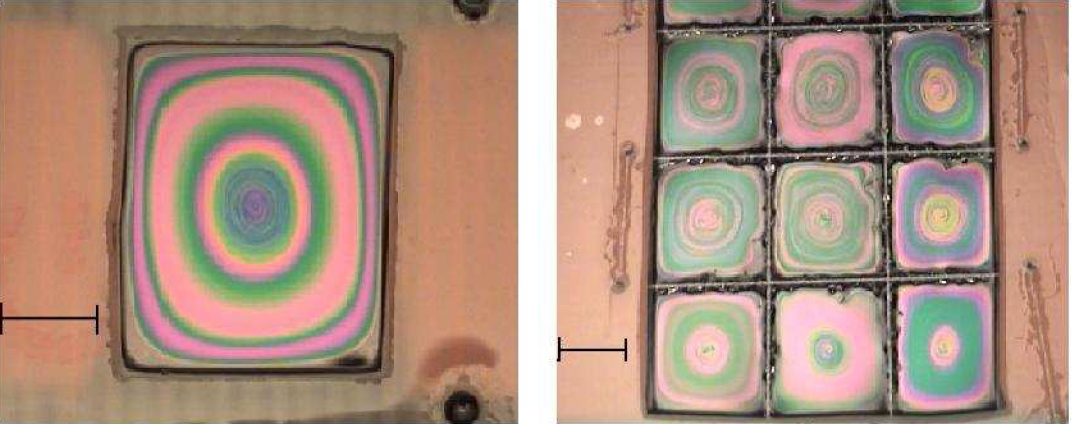
Here’s an interesting effect discovered by a group of Iranian physicists at Sharif University of Technology in Tehran, Iran (it’s not often we hear from these guys).
They placed a thin film of water in a square cell and applied two perpendicular electric fields. One was an external electric field. For the other, they used two copper electrodes to generate a voltage across the cell like an electrolysing cell (although no chemical reaction took place).
So they had a pair of electric fields at right angles acting on this thin film.
The unexpected result is that the film of water begins to rotate. The team has a number of movies of the effect on its website. They call it a liquid film motor and it’s a quite extraordinary effect. At one point they divide their cell into nine smaller ones and the liquid in each cell rotates in exactly the same way.
The question is: what’s causing the rotation? The team can easily control the direction and speed of rotation by varying the relative angle and direction of the electric fields, which rules out the possibility that convection is causing the rotation (something that is seen when a field is applied to some thin films of liquid crystals). Neither does adding salt to water change the effect, ruling out the possibility that ion movement directs the flow.
The rotation occurs in polar liquids but not in non-polar ones so the intrinsic dipole moment of the molecules seems to be crucial. People have been observing the electrohydrodynamics of various types of thin films for a good few years but nobody has seen anything like this. Just what’s going on remains a mystery.
But the puzzle shouldn’t overshadow what looks like an important discovery that could have widespread industrial application in microfluidic devices for mixing.
Ref: arxiv.org/abs/0805.0490: A Liquid Film Motor
Why the smaller helicopters are hard to fly ??

Tiny remote control helicopters have become all the rage in the last few years as lightweight motors and materials have plummeted in price. But if you’ve ever played with one, you’ll know how hard they are to control.
That’s not the result of poor construction. Small helicopters are harder to control than big ones because of the laws of physics: moments of inertia drop in proportion to the fifth power of vehicle size. This gives small helicopters quicker response times, making them more agile. But the real killer is that the main rotor tip speed in a small helicopter is the about the same as it is for a large helicopter. So the ratio of the rotor moments to the moments of inertia can become huge and unmanageable.
That’s when you need to develop a model of helicopter dynamics so you can design remote control systems or an autonomous flight control system that can manage this agility, say Hardian Reza Dharmayanda and pals at Konkuk University in Seoul, South Korea.
And that’s what they’ve done in this paper: built and tested a control system for a Yamaha R-50 helicopter, which uses a two-bladed main rotor with a Bell-Hiller stabilizer bar. The next step, they say, is to make the helicopter fully autonomous using their model.
These guys may be re-inventing the wheel but it’s interesting to see how they’re doing it.
Ref: arxiv.org/abs/0804.4757: Analysis of Stability, Response and LQR Controller Design of a Small-Scale Helicopter Dynamics
Subscribe to:
Posts (Atom)